https://www.clixortech.com/ecommerce-website-developmentWhat Makes a Software Application Scalable? 8 Principles Developers Should Know
A software application may work well with a small number of users. But as traffic, data, and business requirements increase, the same application can begin to experience performance and reliability issues. Scalable software development is important for long-term growth.
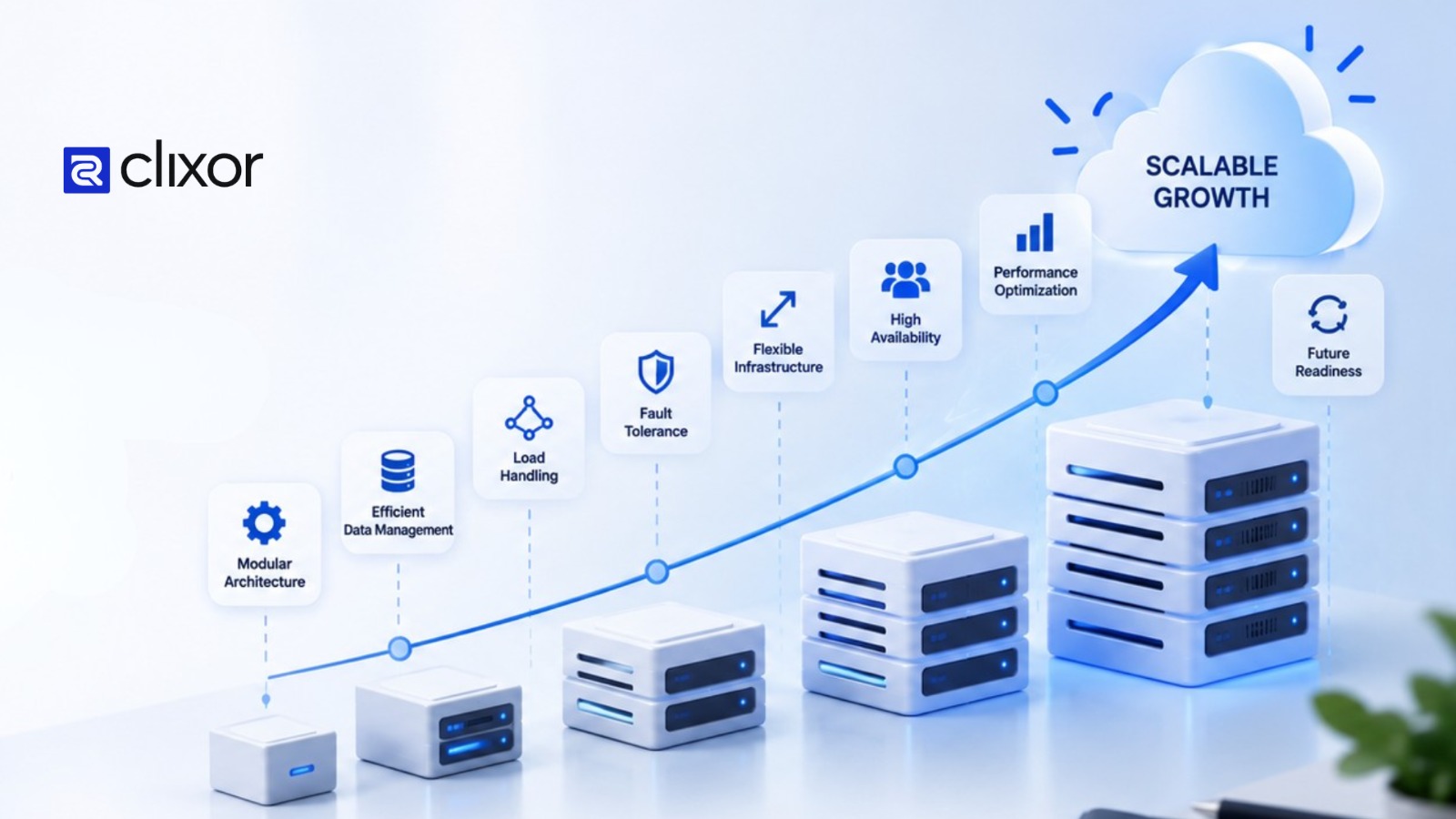
Software scalability means an application can handle increasing workloads without requiring a complete redesign. Developers should consider scalability early in architecture and development, rather than later.
Here are eight important principles developers should know.
- 1. Design a Scalable Architecture
- 2. Build for Efficient Data Management
- 3. Use Caching Where It Makes Sense
- 4. Make Applications Stateless When Appropriate
- 5. Plan for Load Balancing
- 6. Use Asynchronous Processing
- 7. Monitor Performance Continuously
- 8. Choose Infrastructure That Can Grow
- FAQs
- Conclusion
1. Design a Scalable Architecture
An application's architecture provides the foundation for future growth.
Developers should separate important components and design the system so individual parts can be improved or expanded when needed. Depending on the project, this could involve a modular monolith, microservices, or another suitable architecture.
The right choice depends on the application's size, complexity, team, and expected growth.
2. Build for Efficient Data Management
As an application grows, its database can become a major performance bottleneck.
Developers should use appropriate database structures, indexes, queries, and data models. Handle large datasets efficiently so retrieving information doesn't unnecessarily slow the application.
For example, an e-commerce application may need to efficiently search through thousands of products while handling customer orders simultaneously.
3. Use Caching Where It Makes Sense
Applications often request the same information repeatedly. Caching can reduce unnecessary processing and database requests by temporarily storing frequently accessed data.
Developers can cache suitable data such as product information, configuration values, or frequently requested results. However, cached data needs appropriate expiration and update strategies.
4. Make Applications Stateless When Appropriate
Stateless application components can make scaling easier because requests do not have to depend on information stored on a particular server.
This allows additional application instances to handle traffic more flexibly. Session information can instead be managed through suitable external storage or session mechanisms when required.
5. Plan for Load Balancing
When traffic increases, one server may not be enough.
Load balancing distributes incoming requests across multiple application instances. This can help prevent one server from becoming overloaded and supports horizontal scaling.
For growing applications, developers should consider how additional instances can be added without disrupting users.
6. Use Asynchronous Processing
Not every task needs to happen while a user waits for a response.
Time-consuming operations such as sending emails, generating reports, processing files, or handling background jobs can often be moved to asynchronous workflows.
This allows the application to respond faster while background workers handle tasks separately.
7. Monitor Performance Continuously
Scalability is not something developers can plan once and forget.
Monitoring tools can help identify slow requests, resource usage, database problems, errors, and unusual traffic patterns. Regular performance testing can also reveal bottlenecks before they become serious production problems.
Good monitoring helps developers make decisions based on actual application behavior.
8. Choose Infrastructure That Can Grow
Infrastructure plays an important role in software scalability.
Cloud platforms can provide resources that can be adjusted according to application requirements. Developers should design deployment and infrastructure processes so applications can scale without unnecessary manual work.
This can be especially useful for applications with changing traffic patterns or expanding business requirements.
FAQs
What is software scalability?
Software scalability is the ability of an application to handle increasing users, data, traffic, or workloads without major performance problems or a complete redesign.
Why is scalable software development important?
It helps applications accommodate business growth and increasing workloads while reducing the need for major architectural changes later.
What makes an application scalable?
A suitable architecture, efficient data management, caching, load balancing, asynchronous processing, monitoring, and scalable infrastructure all contribute to application scalability.
Is microservices architecture required for scalability?
No. Microservices can support certain scaling requirements, but a well-designed monolithic or modular architecture can also scale effectively.
What is horizontal scaling?
Horizontal scaling means adding more application instances or servers to handle increased workloads rather than relying on a single larger server.
How does cloud infrastructure support scalability?
Cloud infrastructure can allow computing resources to be adjusted as application requirements change, depending on the services and architecture being used.
When should developers consider scalability?
Scalability should be considered during architecture and system design, while avoiding unnecessary complexity for an application's current requirements.
How can developers decide when to scale?
Developers should monitor performance and growth patterns to determine when scaling is needed.
Conclusion
Building a scalable software application requires more than writing efficient code. Developers need to think about architecture, databases, caching, infrastructure, background processing, monitoring, and future workloads.
The goal is not to build the most complicated system possible. Instead, developers should build an architecture that is appropriate for the application's current needs while leaving room for reasonable growth.
At Clixor Technologies, scalable software solutions can be designed around specific business requirements, helping organizations build applications that are prepared for changing users, workloads, and operational needs.