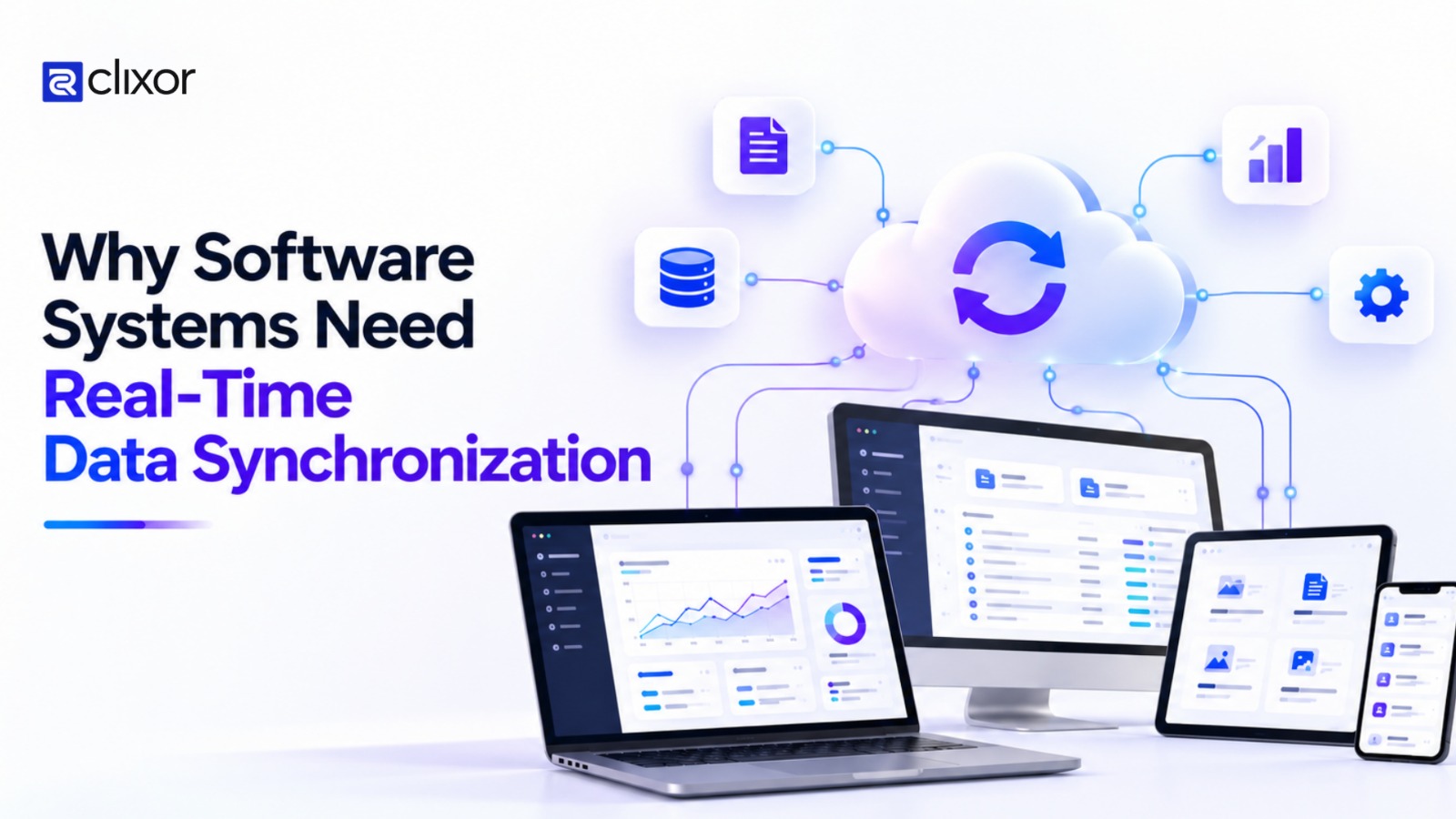
Why Software Systems Need Real-Time Data Synchronisation
Modern businesses depend on multiple software applications to manage customers, sales, inventory, payments, and daily operations. However, when these applications work separately, keeping information updated across every system becomes challenging. This is where real-time data synchronisation becomes important.
Real-time data synchronisation allows connected software systems to exchange updates automatically with minimal delay. It helps businesses keep information consistent, reduce manual work, and improve coordination across departments.
- What Is Real-Time Data Synchronisation?
- Why Do Software Systems Need Real-Time Data Synchronisation?
- How Does Real-Time Data Synchronisation Work?
- Common Challenges in Data Synchronisation
- Frequently Asked Questions
- Conclusion
What Is Real-Time Data Synchronisation?
Real-time data synchronisation updates information across connected applications whenever a relevant change occurs.
For example, when a customer places an order on an online store, the order details can be shared with inventory, payment, and delivery systems. Each application receives the information it needs without requiring employees to enter the same details repeatedly.
Unlike batch processing, which updates information at scheduled intervals, real-time synchronisation aims to process changes as they happen. Technologies such as change data capture can help applications detect database changes and make them available to connected systems.
Why Do Software Systems Need Real-Time Data Synchronisation?
1. Keeps Business Information Accurate
Different applications may contain outdated or conflicting information when updates are not shared properly. Synchronisation helps maintain consistent customer records, product availability, and transaction details across connected systems.
For example, when a product is sold, the inventory system can update the available stock in the online store. This reduces the risk of displaying incorrect stock information.
2. Reduces Manual Data Entry
Manually transferring information between applications consumes time and increases the possibility of errors.
Automated data synchronisation allows systems to exchange information without repeated manual entry. Employees can focus on customer service, planning, and other important tasks instead of updating multiple records.
For businesses connecting different applications, API development and integration can help establish communication between software systems.
3. Improves Customer Experience
Customers expect accurate updates about orders, payments, appointments, and deliveries.
When applications share information quickly, businesses can provide timely notifications and consistent answers. Customer support teams can also access recent order details without waiting for another department to update its records.
4. Supports Faster Business Decisions
Business owners and managers need current information to make informed decisions. Real-time data integration helps reporting tools receive updated information from sales, finance, and inventory applications.
This allows teams to identify stock shortages, monitor transactions, and respond to operational changes more efficiently. Apache Kafka explains how event streaming can capture, process, and distribute data events as they occur.
How Does Real-Time Data Synchronisation Work?
Real-time synchronisation connects applications through technologies such as APIs, webhooks, event-driven systems, and integration platforms.
When information changes in one application, an event or update request can notify another system. The receiving application validates the information and updates its records according to predefined rules.
For example, when an order is confirmed, the system can update inventory, send payment information to the relevant service, and notify the delivery platform.
The exact process depends on the applications, data volume, network conditions, and integration architecture. For businesses building software around these requirements, custom application development can support application-specific workflows and integration needs.
Common Challenges in Data Synchronisation
Businesses must address several challenges when connecting software systems:
- Data conflicts: Multiple applications may update the same record.
- Duplicate records: Repeated requests can create duplicate information.
- Network failures: Temporary connection problems may delay updates.
- Security concerns: Sensitive information requires appropriate access controls and encryption.
- System compatibility: Applications may use different data formats and structures.
Validation rules, error handling, monitoring, and secure integration methods help reduce these problems. Debezium's change data capture features describe approaches for capturing database changes and delivering change events to connected applications.
Frequently Asked Questions
1. What is real-time data synchronisation?
It is the process of automatically sharing and updating information between connected applications with minimal delay.
2. Why is data synchronisation important for businesses?
It improves data consistency, reduces manual work, and helps teams access updated information across different systems.
3. What is the difference between real-time and batch synchronisation?
Real-time synchronisation processes changes as they occur, while batch synchronisation processes collected updates at scheduled intervals.
4. Which technologies support real-time data synchronisation?
APIs, webhooks, message queues, event-driven architectures, and integration platforms can support synchronisation.
5. Is real-time data synchronisation suitable for every business?
Not always. Businesses should consider their operational needs, data volume, system compatibility, security requirements, and implementation costs.
These factors can help determine whether real-time data synchronisation is the right choice for a specific business.
Conclusion
Real-time data synchronisation helps businesses connect applications, maintain accurate information, and reduce unnecessary manual work. It also supports better customer service and more informed business decisions.
By selecting suitable integration technologies and establishing clear data management rules, businesses can create a more connected software environment.
For businesses exploring connected software solutions, Clixor Technologies provides a starting point for learning about its technology services.