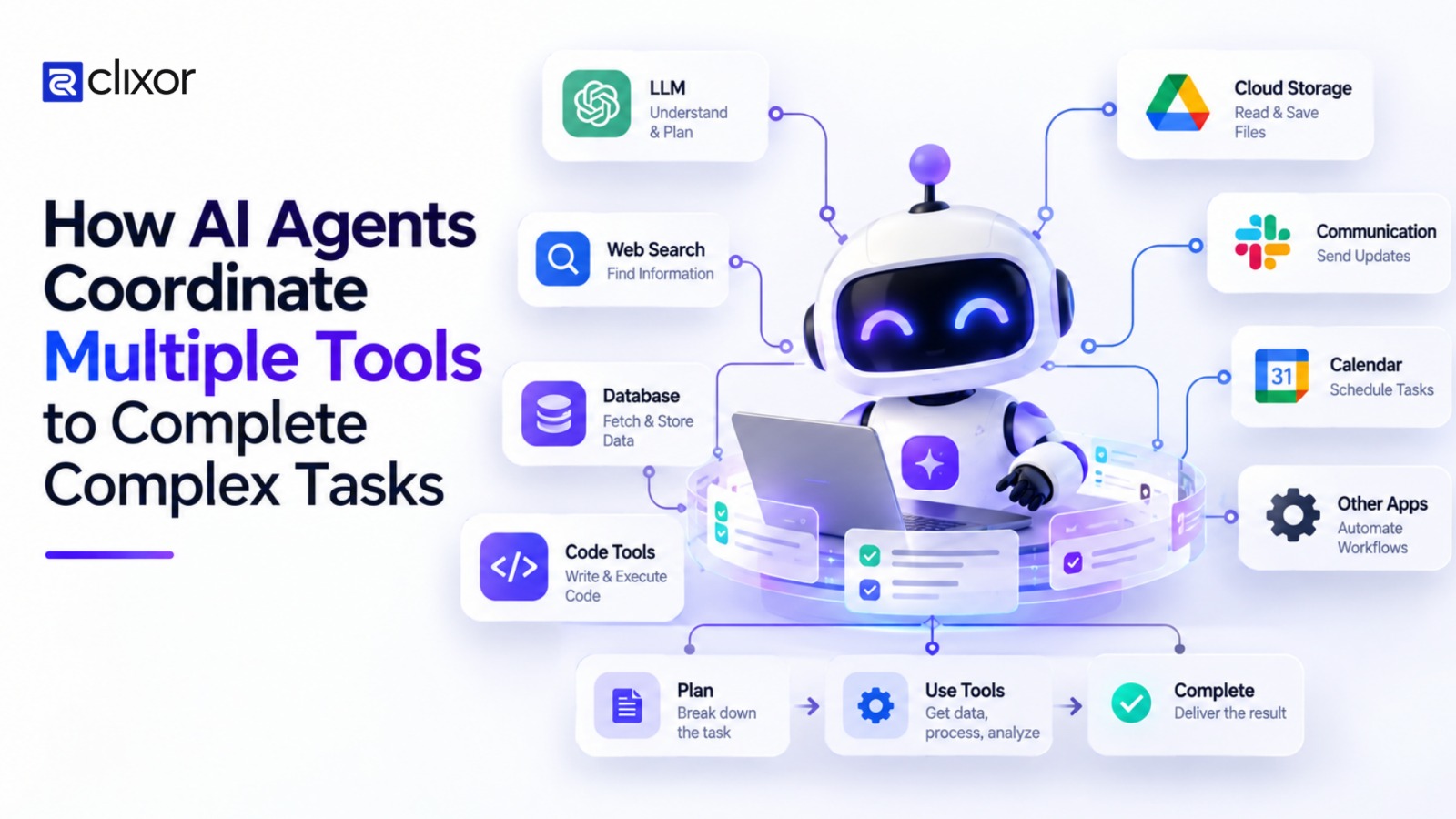
How AI Agents Coordinate Multiple Tools to Complete Complex Tasks
Businesses rely on multiple applications to manage emails, customer information, documents, project tasks, and reports. A single business process may require switching between several tools. AI agents can simplify this work by coordinating multiple tools to complete complex tasks with less manual effort.
When AI agents coordinate multiple tools, they understand a goal, break it into smaller steps, select suitable tools, and use the results to decide what to do next. This approach helps businesses automate workflows that involve multiple applications.
- What Are AI Agents?
- How Do AI Agents Coordinate Multiple Tools?
- A Practical Example of Multi-Tool AI Agents
- Benefits of AI Agent Tool Coordination
- Challenges and Important Considerations
- Frequently Asked Questions
- Conclusion
What Are AI Agents?
AI agents are software systems that use artificial intelligence to work toward specific goals. Depending on their design, they can understand instructions, plan actions, use external tools, and evaluate the results. Learn more about AI agents and their capabilities.
Unlike a basic chatbot that mainly responds to questions, an AI agent may interact with APIs and integrated services, databases, calendars, email platforms, and other applications to perform tasks.
For example, an AI agent could help prepare a weekly sales report by collecting information from a CRM, analysing sales data, and organising the findings into a document.
How Do AI Agents Coordinate Multiple Tools?
AI agents coordinate tools through a structured process that connects planning, execution, and feedback. This process is similar to workflow orchestration, where different services work together in a defined sequence.
1. Understanding the Goal
First, the agent interprets the user’s request and identifies the expected result. If a manager asks for a weekly sales summary, the agent determines which information is required and where it may be available.
2. Breaking the Task into Steps
Complex tasks often involve several smaller actions. The agent creates a sequence of steps based on dependencies and available tools.
For example, it may need to retrieve sales records before calculating revenue and preparing the final report.
3. Selecting the Right Tools
The agent identifies which connected tools can perform each action. It might use a CRM API to retrieve customer records, a spreadsheet tool to calculate totals, and a document application to prepare the report.
Tool selection depends on the agent’s capabilities, permissions, and available information. Technologies such as tool calling allow AI models to request actions from connected tools and receive their results.
4. Executing Actions and Reviewing Results
After selecting a tool, the agent sends a request and examines the returned information. If a request fails or the data is incomplete, it may retry, choose another supported method, or ask the user for clarification.
This feedback process helps the agent manage tasks that require multiple steps.
Businesses can use custom application development to build software that connects these tools and supports their specific operational requirements.
A Practical Example of Multi-Tool AI Agents
Consider a business that wants to follow up with potential customers who have not responded to recent enquiries.
An AI agent could retrieve lead information from a CRM, review previous communication, identify suitable follow-up messages, and prepare draft emails.
After checking the results, it could update the CRM with the follow-up status. Sending messages may require approval, depending on the business’s rules.
This workflow connects several applications while reducing repetitive work for the sales team.
Benefits of AI Agent Tool Coordination
Coordinating multiple tools offers several practical benefits:
- Less manual work: Automates repetitive steps across applications.
- Connected workflows: Moves information between tools without constant manual switching.
- Better task management: Organises actions according to their dependencies.
- Faster information processing: Collects and organises data from different sources.
- Consistent execution: Applies predefined rules and instructions across repeated workflows.
The actual benefits depend on data quality, integration reliability, and how the workflow is designed. Suitable cloud solutions can also help businesses support connected applications and their underlying infrastructure.
Challenges and Important Considerations
AI agents can make mistakes, select unsuitable tools, or misunderstand incomplete instructions. Connected applications may also return outdated information or experience temporary failures.
Businesses should define clear permissions, validate important outputs, monitor tool activity, and protect sensitive data. Human approval is especially useful for financial transactions, external communications, and actions that are difficult to reverse.
Frequently Asked Questions
1. What does it mean when AI agents coordinate multiple tools?
It means an AI agent uses different applications or services together to complete a task that requires several actions.
2. How do AI agents choose which tools to use?
They use their instructions, available tool descriptions, task requirements, and relevant context to select suitable tools.
3. Can AI agents work with existing business software?
Yes. They can connect to compatible applications through APIs, integrations, and other supported interfaces.
4. Are AI agents fully autonomous?
Not necessarily. Their independence depends on their design, permissions, reliability, and the level of human supervision required.
5. Which business tasks can AI agents automate?
They can support report preparation, customer enquiry handling, information retrieval, workflow coordination, and other repetitive multi-step processes.
Conclusion
AI agents can coordinate multiple tools to complete complex tasks by combining planning, application integration, and feedback. This allows businesses to connect separate operations into more organised workflows.
Successful implementation requires reliable integrations, appropriate permissions, and clear human oversight. Businesses exploring AI-powered automation can work with Clixor Technologies to identify suitable workflows and build solutions around their operational needs.