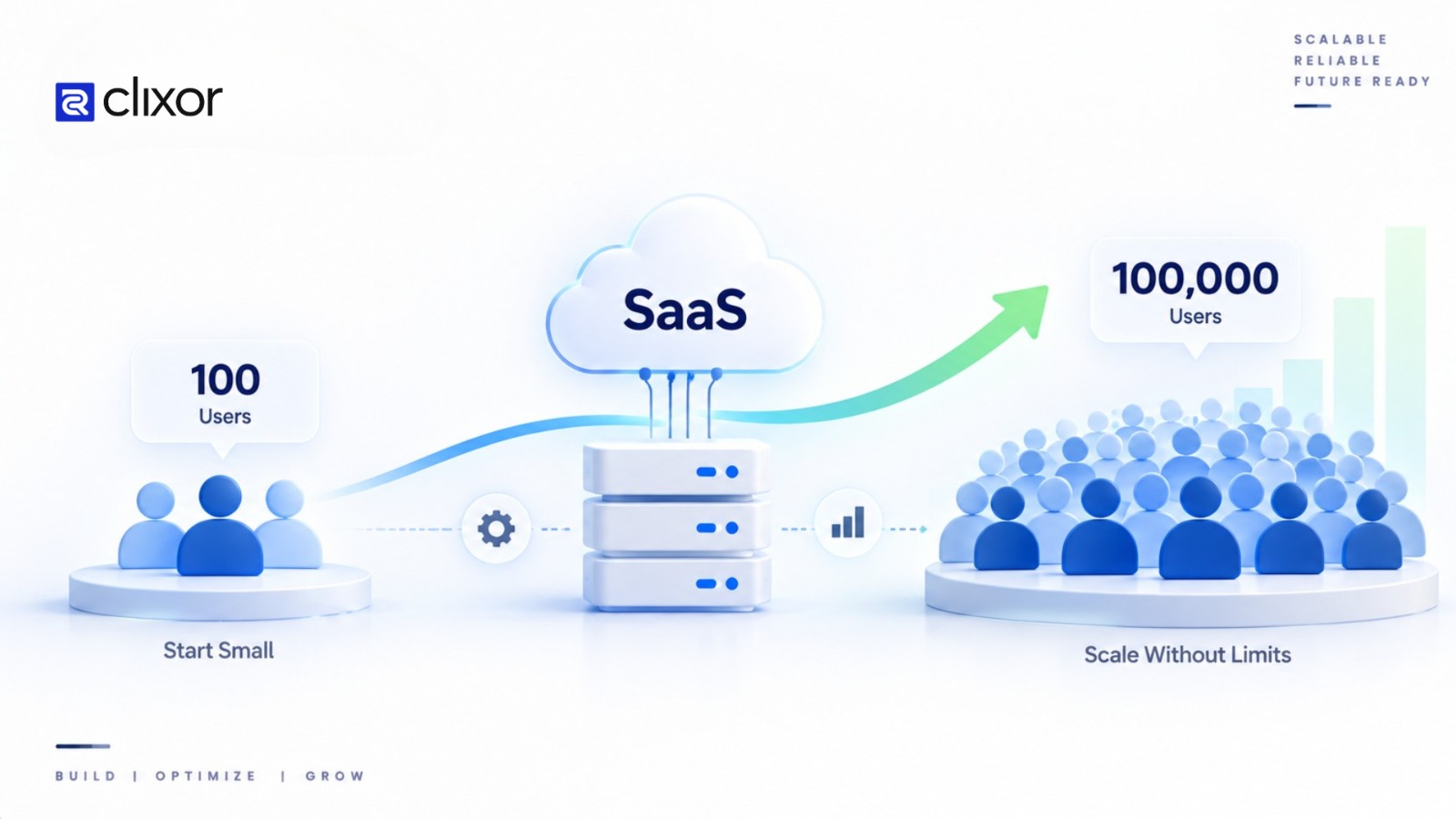
What Makes a SaaS Application Scalable From 100 to 100,000 Users?
Building a SaaS application for the first 100 users is very different from building one that can support 100,000 users. At a small scale, a simple server and database may be enough. As the user base grows, the application must handle more requests, larger amounts of data, and higher traffic without becoming slow or unreliable.
So, what makes a SaaS application scalable from 100 to 100,000 users? The answer is not one technology. Scalability comes from a combination of architecture, databases, infrastructure, caching, security, and good development practices.
- What Does SaaS Scalability Mean?
- 1. Scalable Application Architecture
- 2. Efficient Database Design
- 3. Caching for Frequently Used Data
- 4. Load Balancing
- 5. Auto Scaling and Cloud Infrastructure
- 6. Asynchronous Processing
- 7. Monitoring and Performance Testing
- FAQs
- How Clixor Tech Approaches Scalable SaaS Development
- Conclusion
What Does SaaS Scalability Mean?
SaaS scalability means an application can support increasing numbers of users while maintaining acceptable performance and reliability.
A scalable SaaS application should be able to handle growth without requiring a complete redesign every time the number of users increases.
For example, an application designed for 100 users might run on one server. When thousands of users access it simultaneously, the system may require load balancing, additional application servers, caching, database optimization, and automated scaling.
1. Scalable Application Architecture
The application architecture has a major impact on long-term scalability.
A well-structured SaaS application separates responsibilities between components such as the frontend, backend, database, authentication, file storage, and external services.
Depending on the product, businesses may use a modular monolith or microservices architecture. The right choice depends on application complexity and operational requirements.
The goal is to make individual parts easier to improve or scale without affecting the entire system.
Businesses developing applications for long-term growth can consider custom application development to design the architecture around their specific scalability and operational requirements.
2. Efficient Database Design
The database can become a bottleneck as user activity increases.
A scalable SaaS application needs proper indexing, optimized queries, suitable database structures, and efficient data access patterns.
For example, if a dashboard repeatedly searches millions of records without appropriate indexes, response times can increase significantly.
Database replication, read replicas, partitioning, or sharding may become useful as the system grows, depending on the workload.
3. Caching for Frequently Used Data
Caching reduces repeated processing by temporarily storing frequently requested information.
A SaaS application can cache suitable data such as configuration values, frequently accessed records, API responses, or session-related information.
Caching can reduce database load and improve response times, particularly when many users request similar information.
4. Load Balancing
When one application server is responsible for thousands of users, it can become a performance bottleneck.
Load balancing distributes incoming requests across multiple application servers.
This allows the system to handle more traffic and improve availability by redirecting traffic when a server becomes unavailable.
For businesses designing systems that need to handle changing workloads, AWS scalable and resilient application architecture provides useful architectural guidance around scalability and availability.
5. Auto Scaling and Cloud Infrastructure
Cloud infrastructure can help SaaS applications respond to changing workloads.
Instead of running the same number of servers at all times, an application can be configured to add or remove computing resources based on demand.
For example, a business application may require more resources during peak usage and fewer resources during quieter periods.
Microsoft's scaling guidance explains how scaling strategies can help applications adapt to changing workloads.
For businesses that need infrastructure capable of supporting growing SaaS workloads, cloud solutions can form part of the overall application architecture.
6. Asynchronous Processing
Not every task needs to happen while the user is waiting.
Tasks such as sending emails, generating reports, processing files, or creating notifications can be moved to background jobs using queues.
This keeps the main application responsive while longer operations are processed separately.
For SaaS applications that need different systems and services to communicate efficiently, API development and integration can also support the exchange of data between application components and external platforms.
7. Monitoring and Performance Testing
Scalability should be tested before the application reaches its limits.
Monitoring tools can track CPU usage, memory consumption, database performance, API response times, errors, and traffic patterns.
Load testing can also help developers understand how the application behaves under increasing numbers of concurrent users.
FAQs
1. Can a SaaS application built for 100 users support 100,000 users?
It can, but the architecture and infrastructure may need to evolve as usage increases. Scalability should be considered from the early development stages.
2. What is the biggest factor in SaaS scalability?
There is no single factor. Architecture, database design, infrastructure, caching, application code, and monitoring all contribute to scalability.
3. Does every SaaS application need microservices?
No. A well-designed modular monolith can also scale effectively. Microservices are useful when their additional complexity is justified by the application’s requirements.
4. How does caching help SaaS scalability?
Caching can reduce repeated database queries and processing, allowing the application to serve frequently requested information more efficiently.
5. When should businesses plan for scalability?
Scalability should be considered during architecture and development rather than waiting until performance problems appear.
How Clixor Tech Approaches Scalable SaaS Development
Building a scalable SaaS product requires more than simply adding servers. The application needs an architecture that can evolve with business requirements and user growth.
Clixor Technologies focuses on software development with attention to application architecture, database performance, APIs, security, and scalability. A practical approach helps businesses build applications that can adapt as their customer base grows.
Conclusion
Scaling a SaaS application from 100 to 100,000 users requires planning across the entire technology stack. Efficient architecture, database optimization, caching, load balancing, cloud infrastructure, background processing, and continuous monitoring all play important roles. Together, these elements help build a system that can grow without losing performance or reliability.
The objective is not to build the most complicated system from day one. Instead, businesses should build a strong foundation that can evolve as usage, data, and business requirements grow. That approach creates a better path for long-term scalability.