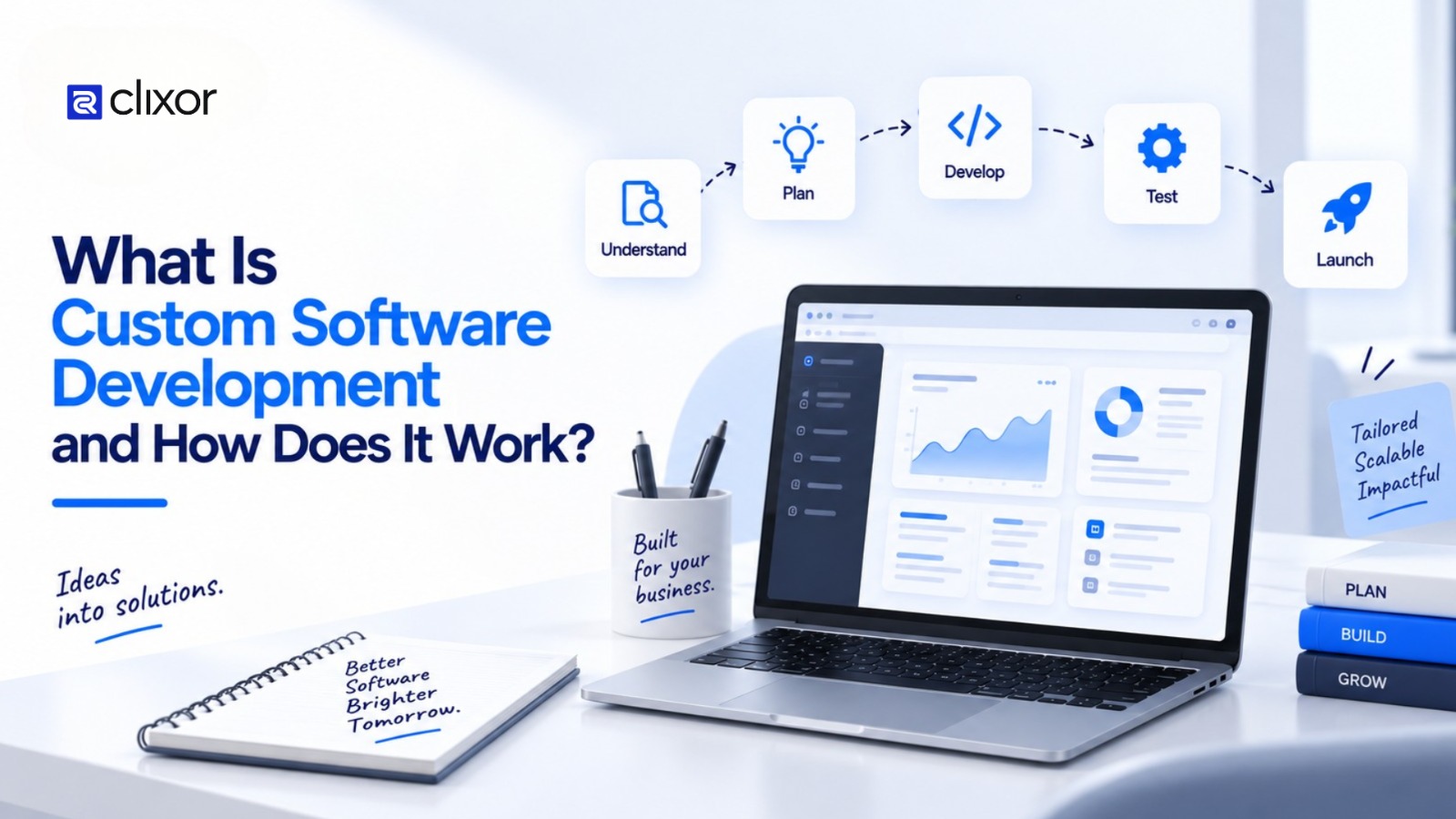
What Is Custom Software Development and How Does It Work?
Businesses use software for many everyday activities, from managing customers and sales to handling internal operations. While ready-made software can meet common requirements, it may not always fit a particular business's way of working. This is where custom software development can be useful.
Custom software is created around specific business needs, workflows, users, and goals. Instead of changing business processes to fit existing software, businesses can build a solution that meets their actual requirements.
- What Is Custom Software Development?
- How Does Custom Software Development Work?
- When Should a Business Consider Custom Software?
- Custom Software vs Ready-Made Software
- Frequently Asked Questions
- Conclusion
What Is Custom Software Development?
Custom software development is the process of planning, designing, building, testing, and maintaining software for a specific business or organization.
Unlike ready-made software, a custom solution is developed based on the requirements of its intended users. It can include specific features, user roles, workflows, integrations, dashboards, and other functions the business needs.
For example, a company may need software to manage customer enquiries, sales activities, internal approvals, and reports in one place. A custom application can be designed around that particular workflow.
How Does Custom Software Development Work?
Custom software development usually follows several important stages.
1. Requirement Analysis
The first step is understanding the business problem.
The development team studies the existing workflow, identifies challenges, understands user requirements, and defines what the software should accomplish. Clear requirements provide a strong foundation for the project.
2. Planning
After understanding the requirements, the project is planned.
This includes deciding the software structure, technology, database requirements, integrations, user roles, and development approach. Proper planning can also help identify technical challenges early.
3. UI and UX Design
The next stage focuses on how users will interact with the application.
The interface should be simple enough for users to understand and practical for completing everyday tasks. Good UX design can make complex business processes easier to manage.
4. Development
Developers then build the application based on the approved requirements and design.
Features such as user accounts, dashboards, databases, workflows, notifications, APIs, and reports may be developed depending on the project.
5. Testing
The completed software is tested before it is released.
Testing helps identify functional errors, usability issues, integration problems, and other issues that could affect the application. Different parts of the system are checked to ensure they work as expected.
6. Deployment and Maintenance
Once testing is completed, the software can be deployed for users.
Development does not necessarily end after launch. Businesses may need updates, security improvements, performance optimization, new integrations, or additional features as their requirements change.
When Should a Business Consider Custom Software?
Custom software may be worth considering when existing applications do not properly support a business's processes.
Some common situations include:
- The business depends heavily on manual work or spreadsheets.
- Existing software lacks important business-specific features.
- Multiple systems need to share information.
- The business requires specific workflows or approval processes.
- Existing applications are becoming difficult to scale or maintain.
The decision should be based on actual business requirements rather than simply choosing custom software because it offers more features.
Custom Software vs Ready-Made Software
Ready-made software is built for a broad range of users and can often be implemented quickly. Custom software is designed for specific requirements and usually involves more planning and development.
The better option depends on factors such as business processes, budget, required integrations, number of users, scalability, and long-term goals.
Frequently Asked Questions
1. What is custom software development?
Custom software development is the process of creating software specifically for the requirements, workflows, and users of a particular business or organization.
2. How long does custom software development take?
The development time depends on the project's features, complexity, integrations, design requirements, testing, and overall scope.
3. Is custom software better than ready-made software?
Not necessarily. Custom software can be useful when a business has unique requirements that existing solutions cannot support effectively.
4. Can custom software integrate with existing applications?
Yes. Custom applications can often connect with existing systems through APIs and other suitable integration methods.
5. Can custom software be changed after development?
Yes. Custom software can be updated with new features, integrations, security improvements, and other changes as business requirements evolve. Additional questions can be added as needed to keep the FAQ complete.
Conclusion
Custom software development provides a way for businesses to create digital solutions around their actual needs instead of adapting every process to a standard application. From requirement analysis and planning to design, development, testing, and maintenance, each stage contributes to building a useful solution.
For businesses with specific workflows, complex processes, or integration requirements, custom software can be a practical approach when existing solutions are no longer enough.
At Clixor Technologies, software solutions can be developed around specific business requirements and workflows, helping organizations create applications that support their operational needs.