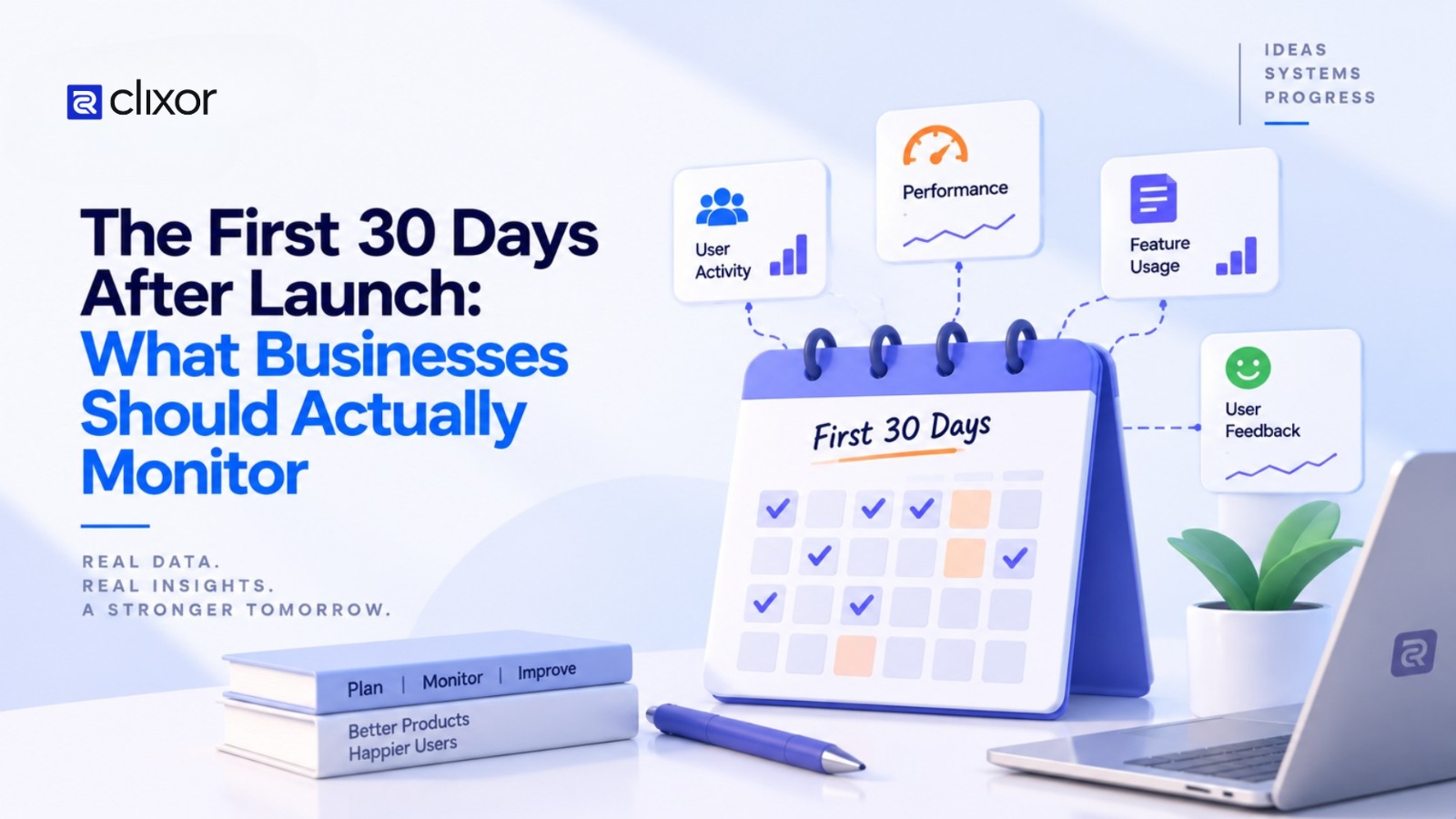
The First 30 Days After Launch: What Businesses Should Actually Monitor
Launching a website, mobile app, or business application is a major milestone, but development continues after the product goes live. The first 30 days can reveal how the product performs in real-world conditions.
During this period, businesses should look beyond whether the application works. They should understand how users interact with it, where problems arise, and whether it supports the original business goals.
A structured post-launch monitoring process can help teams identify issues early and make informed improvements.
- 1. Monitor Website and Application Performance
- 2. Watch for Errors and Technical Problems
- 3. Understand How Users Behave
- 4. Collect Real User Feedback
- 5. Check Security and Access Controls
- 6. Compare Results With Business Goals
- What Should Businesses Do After 30 Days?
- Conclusion
1. Monitor Website and Application Performance
Performance should be one of the first things businesses check after launch.
Monitor page loading, response times, server performance, and unexpected slowdowns. A website that worked well during development may behave differently when real users start accessing it.
For example, an application may perform normally with test users but become slower when several users access the same feature at once.
Regular application performance monitoring helps identify these problems before they become larger issues.
2. Watch for Errors and Technical Problems
Not every problem appears during testing.
Users may discover broken links, failed form submissions, unexpected error messages, or issues with specific devices and browsers.
Development teams should regularly review application logs and error reports. If the same error appears repeatedly, investigate it rather than ignore it.
This is especially important for business applications where a small technical issue can interrupt an important workflow.
3. Understand How Users Behave
The first month is also an opportunity to understand actual user behaviour.
Businesses can examine which pages users visit, which features they use most, and where they leave the website or application.
Suppose an online enquiry form receives many visitors but very few completed submissions. The problem may not be the traffic. The form itself could be confusing or unnecessarily long.
User behavior can reveal opportunities that were not obvious during development.
4. Collect Real User Feedback
Analytics can show what users do, but feedback can explain why they do it.
Ask customers, employees, or other users about their experience. Look for repeated complaints, confusing steps, missing information, and useful suggestions.
Not every suggestion needs to become a new feature. Feedback should be reviewed against business priorities before changes are made.
5. Check Security and Access Controls
Security should continue to be reviewed after launch.
Businesses should verify user permissions, account access, authentication processes, and important system configurations. Unused accounts and unnecessary access should also be reviewed.
For applications handling business or customer information, ongoing security checks are an important part of responsible software management.
6. Compare Results With Business Goals
Finally, connect technical performance with business outcomes.
Ask simple questions:
- Is the website generating enquiries?
- Are customers completing important actions?
- Are employees using the new system?
- Are manual processes becoming easier?
- Are the original project objectives being achieved?
A technically successful launch is not necessarily a business success if the product does not solve the intended problem.
What Should Businesses Do After 30 Days?
At the end of the first month, review performance data, technical issues, user feedback, and business results together.
Create three categories: fix now, improve later, and monitor further. This prevents teams from making random changes based on individual requests.
For businesses working with Clixor Technologies, post-launch improvements can be approached as an ongoing development process rather than a one-time activity.
Conclusion
The first 30 days after launch are a chance to learn how a digital product performs in the real world.
By monitoring performance, errors, user behavior, feedback, security, and business outcomes, companies can make better decisions about what needs attention next.
A successful launch is the beginning of improvement—not the end of development.