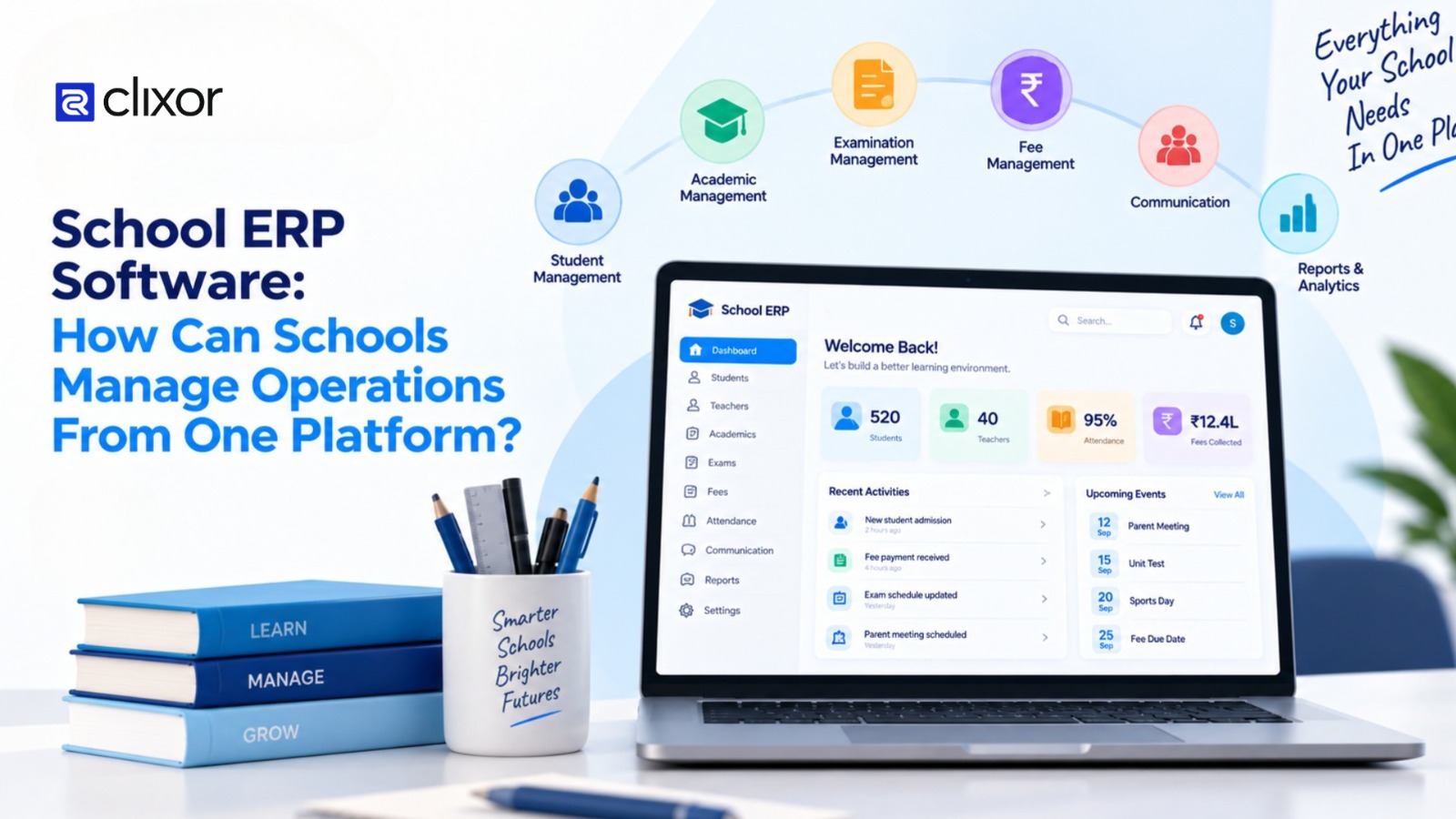
School ERP Software: How Can Schools Manage Operations From One Platform?
Managing a school involves much more than teaching students. Administrators must handle attendance, fees, student records, examinations, staff information, communication, and many other daily tasks. When schools manage these tasks with separate systems or manual records, keeping information organised becomes difficult.
School ERP software brings these activities together in one centralised platform. It helps schools manage different departments, reduce repetitive work, and access important information more easily.
- What Is School ERP Software?
- How Can Schools Manage Operations From One Platform?
- What Are the Benefits of Using a School ERP System?
- Why Is One Platform Better Than Multiple Systems?
- FAQs About School ERP Software
- Conclusion
What Is School ERP Software?
School ERP software is a centralised system designed to manage a school's academic, administrative, and operational activities.
Instead of maintaining separate spreadsheets, paper records, and disconnected applications, schools can use a single school ERP system to manage information across different departments.
Depending on the system, it can include modules for students, teachers, parents, fees, attendance, examinations, communication, and administration.
For a broader understanding of how enterprise systems bring different organisational processes together, businesses and institutions can refer to SAP's overview of ERP.
How Can Schools Manage Operations From One Platform?
A school ERP system connects different processes so that information can move between departments without repeated data entry.
1. Student Information Management
Schools can maintain student profiles, admission details, contact information, academic records, and other important data in one place.
For example, when an administrator needs to check a student's basic information, they can find it through the student management module instead of searching through multiple files.
For schools that require a system designed around their own admission and student-management workflows, custom application development can provide more flexibility.
2. Attendance Management
Teachers can record student attendance digitally instead of maintaining manual registers.
Administrators can also view attendance records and identify students with frequent absences. Parents may receive attendance updates through the system's communication features.
3. Fee Management
Managing school fees manually can involve invoices, receipts, payment tracking, and follow-ups.
With school fee management features, schools can maintain fee structures, track payments, identify pending amounts, and generate relevant reports from one system.
4. Examination and Academic Management
Schools can organise examination schedules, marks, grades, and academic records through the ERP platform.
Teachers can update marks, while administrators can access academic information for reporting and planning.
Digital education platforms increasingly use technology to support the management and delivery of educational activities. UNESCO provides resources on technology in education.
5. Staff and Teacher Management
A school ERP can also help manage teacher and staff information, attendance, responsibilities, and other administrative records.
This gives school management a clearer view of staff-related information without maintaining separate records for every department.
6. Communication With Parents
Communication is an important part of school management.
A school communication software module can help schools share announcements, attendance updates, event information, notices, and other messages with parents and students.
For example, instead of sending the same announcement through different channels, the school can publish it through a centralised communication system.
What Are the Benefits of Using a School ERP System?
A centralised school management software solution can help schools:
- Reduce repetitive administrative work.
- Keep student and staff information organised.
- Improve access to school records.
- Reduce dependency on paper-based processes.
- Simplify fee and attendance tracking.
- Improve communication between schools and parents.
- Generate reports more efficiently.
- Connect different administrative processes.
The exact benefits depend on the modules and workflows implemented by the school.
Schools also need to consider how student and staff information is protected when moving records into digital systems. The U.S. Department of Education's student privacy resources provide information on protecting student education records in the United States.
Why Is One Platform Better Than Multiple Systems?
When different departments use disconnected tools, information may need to be entered repeatedly. This can create unnecessary work and make it harder to maintain consistent records.
A school ERP system provides a shared platform where different functions can work with connected information.
For example, student information entered during admission can potentially be used across attendance, academic, fee, and communication modules instead of being entered separately.
When a school needs different applications to exchange information, API development and integration can help connect systems and reduce repeated data entry.
Microsoft also provides information on education technology and digital transformation for educational institutions adopting digital tools and services.
FAQs About School ERP Software
1. What is the main purpose of school ERP software?
The main purpose is to centralise school operations such as student management, attendance, fees, academics, staff management, and communication.
2. Can school ERP software manage student attendance?
Yes. Most school ERP systems include attendance management features that allow teachers and administrators to record and monitor attendance digitally.
3. Can parents access school ERP systems?
Many platforms provide parent portals or mobile access where parents can view relevant information such as attendance, fees, notices, and academic updates.
4. Does school ERP software replace manual records?
It can reduce the need for many manual records by moving school information and processes into a centralised digital system.
5. Can a school ERP system be customised?
Customisation depends on the software provider. Some systems can be configured or developed to match a school's specific workflows and requirements.
Conclusion
School ERP software can bring multiple school operations together within a single digital platform. From student records and attendance to fees, examinations, staff information, and parent communication, schools can manage important processes without depending on disconnected systems. This creates a more organised and connected way to manage day-to-day operations and supports clearer, more efficient school management.
For schools planning to move from manual processes to a more connected digital workflow, a well-designed school ERP system can provide a structured foundation for managing day-to-day operations. It can also support a smoother transition to centralised school management.
Clixor Technologies can help businesses and institutions explore software solutions based on their specific operational requirements, including customised applications and digital management systems.