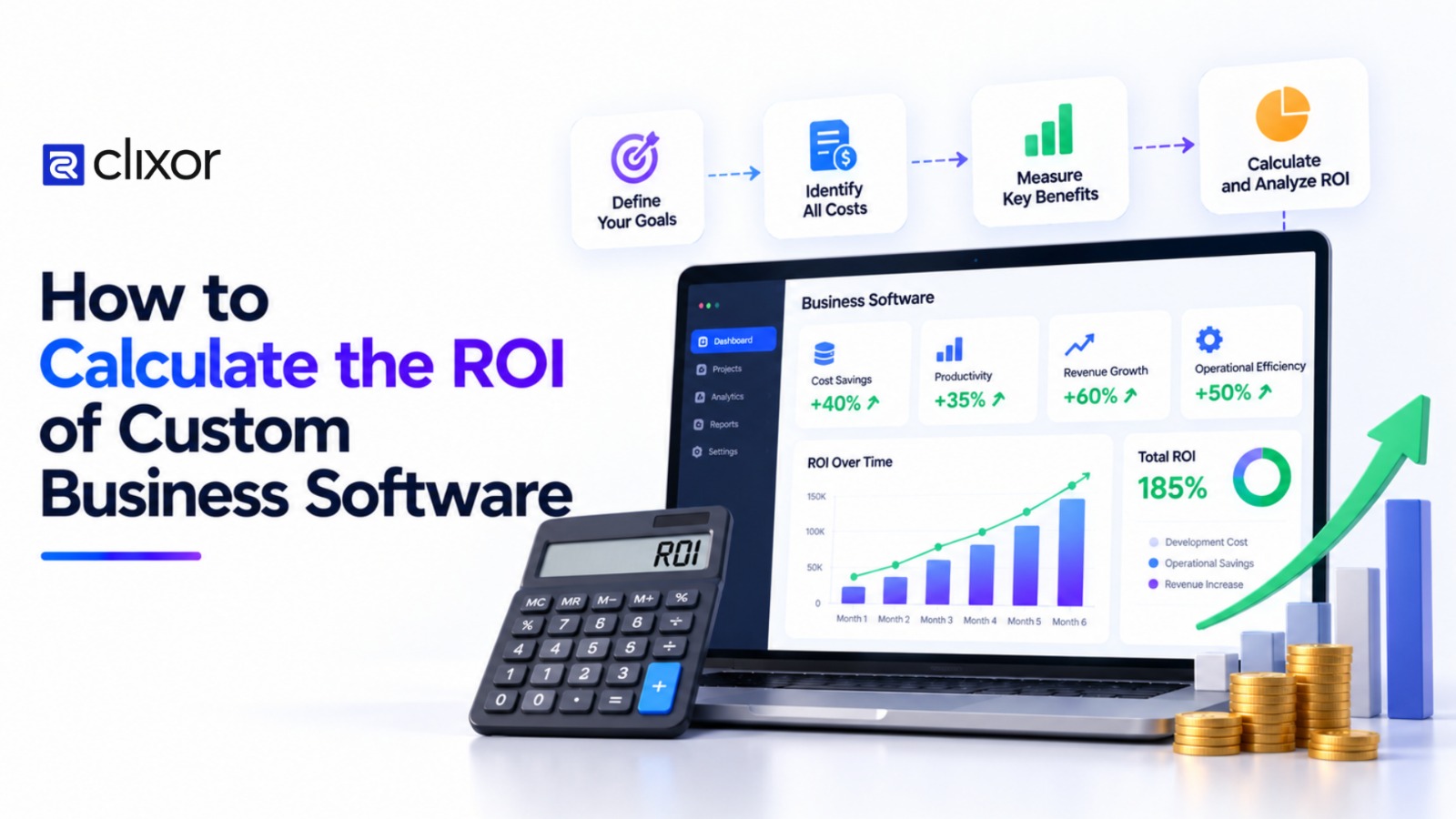
How to Measure ROI of Custom Business Software
Investing in custom business software can help companies improve productivity, reduce manual work, and manage operations more efficiently. Before investing, business owners should determine whether the expected benefits justify the cost.
Calculating the ROI of custom business software helps businesses compare their investment with the financial benefits they receive. It also supports better decisions about development budgets, business requirements, and future improvements. The U.S. Small Business Administration's guide to business finances provides useful context for evaluating business costs and financial performance.
- What Is the ROI of Custom Business Software?
- How to Calculate Software ROI
- Example: Calculating Custom Software ROI
- Frequently Asked Questions
- Conclusion
What Is the ROI of Custom Business Software?
Return on investment (ROI) measures the financial return generated by an investment compared with its total cost. For custom software, this includes development expenses and the savings or additional revenue the software generates.
A positive ROI indicates that the measured financial benefits exceed the investment cost. Even so, businesses should also consider how long it takes to recover their investment.
How to Calculate Software ROI
The standard ROI formula is:
ROI (%) = ((Total Benefits − Total Costs) ÷ Total Costs) × 100
To calculate the ROI of custom business software, identify all relevant expenses and estimate the financial benefits over a defined period. Businesses planning a tailored solution can explore custom app development services to understand the development process and requirements.
Step 1: Calculate the Total Software Cost
Include more than the initial development price. Consider expenses such as:
- Software design and development
- Testing and deployment
- Third-party tools and integrations
- Employee training
- Hosting and infrastructure
- Maintenance, support, and updates
For example, a company may spend $20,000 developing software and another $5,000 on implementation and first-year maintenance. Its total first-year investment would be $25,000.
Step 2: Identify the Financial Benefits
Measure how the software improves business performance. Benefits may include reduced administrative expenses, fewer errors, faster processing, lower operating costs, and additional sales.
For example, automated invoice processing may reduce the hours employees spend entering data manually. You can convert the resulting time savings into an estimated monetary value. The U.S. Department of Energy's guidance on measurement and verification illustrates why measuring actual performance against a baseline matters when evaluating savings.
Step 3: Estimate Annual Savings
Calculate the difference between operating costs before and after implementation. Use realistic figures based on actual workflows whenever possible.
Suppose the software saves $1,500 per month in labour and administrative costs. The estimated annual savings would be $18,000.
Step 4: Include Additional Revenue
Custom software may also improve customer service, reduce missed enquiries, or help teams process more orders.
Include additional revenue only when it can reasonably be linked to the software. Avoid counting projected sales as guaranteed income. The NIST Cybersecurity Framework also provides a useful example of how businesses can consider cybersecurity risks as part of technology-related decisions.
Example: Calculating Custom Software ROI
Assume a business invests $25,000 in custom software and receives $40,000 in total financial benefits during the first year.
Using the standard formula:
ROI = (($40,000 − $25,000) ÷ $25,000) × 100
First-year ROI = 60%
This example assumes that the $40,000 represents the total financial benefit before subtracting the $25,000 investment. Actual results depend on implementation costs, usage, and business performance.
Businesses evaluating how software fits their workflows can also review Clixor's software development case studies for examples of technology projects and their business context.
Frequently Asked Questions
1. What is a good ROI for custom software?
There is no universal target. A reasonable ROI depends on development costs, business goals, risks, and the expected payback period.
2. How long does custom software take to deliver ROI?
It depends on project complexity, adoption, implementation costs, and the benefits achieved. Some projects recover their costs faster than others.
3. Should maintenance costs be included in ROI?
Yes. Hosting, support, updates, and ongoing maintenance should be included when calculating ROI over the selected period.
4. Can productivity improvements be included in software ROI?
Yes. Time savings can be converted into estimated financial value, provided the calculation uses realistic assumptions and avoids double-counting benefits.
5. Is custom software more cost-effective than ready-made software?
It depends on the business. Custom software may fit specific workflows better, while ready-made solutions may have lower initial costs and faster implementation.
Conclusion
Calculating the ROI of custom business software helps companies understand the financial value of their technology investments. By tracking development costs, operational savings, productivity improvements, and additional revenue, businesses can make decisions based on measurable results.
Clixor Technologies can help businesses evaluate software requirements and explore digital solutions that support their operational goals. A clear understanding of expected costs and benefits is an important starting point for building software that delivers long-term business value.
Word Count: Approximately 600 words, excluding SEO details.