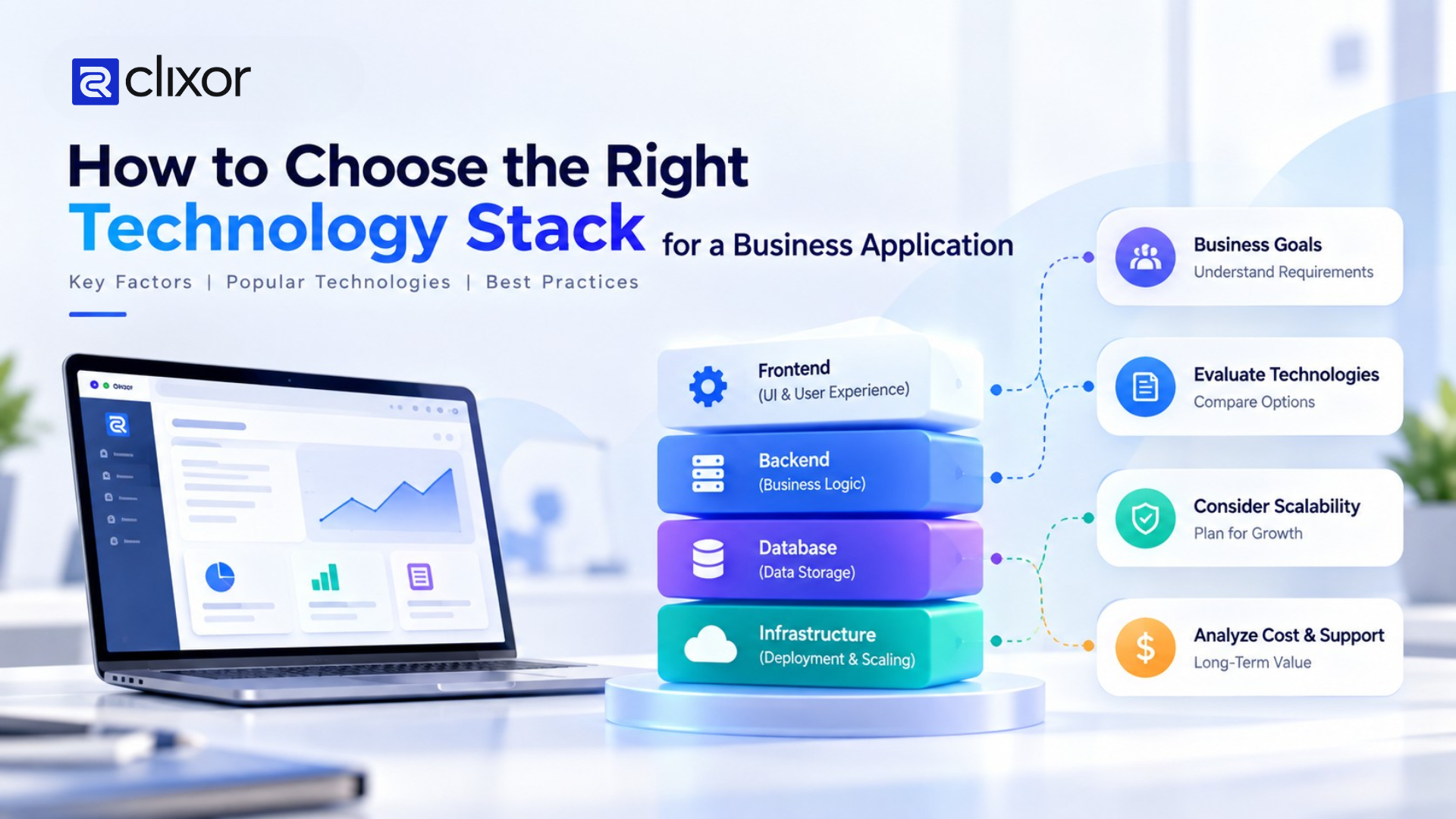
How to Choose the Right Technology Stack for a Business Application
Choosing the right technology stack for a business application is an important decision. The technologies selected during development can affect the application's performance, security, scalability, maintenance, and overall development cost.
A technology stack usually includes the programming language, frontend framework, backend technology, database, APIs, and development tools used to build an application. The right combination depends on what the business application needs to achieve, rather than simply choosing the latest technology.
- What Is a Technology Stack?
- How to Choose the Right Technology Stack for a Business Application
- Common Technology Stack Components
- 5 FAQs About Choosing a Technology Stack
- Conclusion
What Is a Technology Stack?
A technology stack is the collection of technologies used to develop and run a software application.
For example, a business application might use React.js for the frontend, Node.js for the backend, and MySQL for data storage. Another application may use Laravel, PHP, and MySQL.
The best technology stack depends on factors such as application requirements, expected users, integrations, security needs, and future growth.
How to Choose the Right Technology Stack for a Business Application
1. Start With Business Requirements
Before selecting technologies, clearly define what the application needs to do.
Consider questions such as:
- Who will use the application?
- What business processes will it manage?
- What type of data will it store?
- Will it need third-party integrations?
- Does it require real-time updates?
- How many users are expected?
For example, a simple internal management system may not need the same architecture as a large customer-facing platform.
2. Consider Scalability
A business application should be able to handle growth without requiring a complete rebuild.
Think about future requirements such as:
- More users
- Larger amounts of data
- Additional features
- Multiple locations
- New integrations
Choosing a technology stack for scalability can make future development easier and reduce technical limitations as the business grows. Microsoft's scale-out architecture guidance explains how applications can be designed to handle increasing workloads by adding resources as demand grows.
3. Evaluate Performance Requirements
Different applications have different performance needs.
An application handling large amounts of data or frequent user requests may require a backend and database architecture designed for efficient processing. Applications with interactive dashboards may also need a responsive frontend framework.
Performance should therefore be considered alongside functionality when choosing the technology stack.
For database-heavy applications, understanding how the selected database handles indexes and query performance can also influence technology decisions.
4. Check Security Requirements
Security should be considered from the beginning of software development.
The technology stack should support secure authentication, authorization, data protection, API security, and regular maintenance.
For applications handling customer information, financial records, employee data, or other sensitive information, security requirements should influence technology selection.
The OWASP Application Security Verification Standard (ASVS) provides a useful security reference for applications that need structured security requirements.
5. Think About Integrations
Many business applications need to communicate with other systems such as payment platforms, CRM software, accounting tools, email services, or third-party APIs.
A suitable technology stack should make these integrations practical and maintainable.
For example, an application that needs several external APIs may benefit from a backend architecture designed specifically for reliable API communication.
For businesses building applications that depend heavily on system integration, Clixor's API Development & Integration services can be relevant when planning the application architecture.
6. Consider Development and Maintenance
Choosing a technology is not only about building the first version.
Businesses should also consider how easily developers can maintain, update, test, and extend the application.
A well-supported technology with suitable development resources can make long-term maintenance easier.
For larger or more specialized applications, custom application development can allow the technology choices and architecture to be aligned with specific business requirements.
Common Technology Stack Components
A business application commonly includes:
| Layer | Examples |
|---|---|
| Frontend | React.js, Angular, Vue.js |
| Backend | Node.js, Laravel, Django |
| Database | MySQL, PostgreSQL, MongoDB |
| API | REST, GraphQL |
| Hosting | AWS, Azure, Google Cloud |
The exact combination should be selected according to the application's requirements rather than following a fixed formula.
5 FAQs About Choosing a Technology Stack
1. What is the best technology stack for a business application?
There is no single best stack. The right choice depends on application requirements, scalability, security, integrations, budget, and maintenance needs.
2. Should businesses always use the latest technology?
Not necessarily. A mature and well-supported technology can sometimes be more suitable than a newer option.
3. How does technology stack affect software cost?
The stack can influence development time, developer availability, infrastructure requirements, and long-term maintenance costs.
4. Can a technology stack be changed later?
Yes, but changing major technologies after development can be complex and expensive. Planning the architecture carefully at the beginning can reduce this risk.
5. Should businesses choose custom software technologies based on their requirements?
Yes. Business requirements should be the starting point when selecting technologies for custom software development.
Conclusion
Choosing the right technology stack for a business application requires more than selecting popular programming languages or frameworks. Businesses should consider their current requirements, future growth, security, performance, integrations, and long-term maintenance.
A carefully planned technology stack can provide a stronger foundation for reliable and scalable software. At Clixor Technologies, technology choices can be aligned with the specific business requirements, application goals, and long-term development needs.