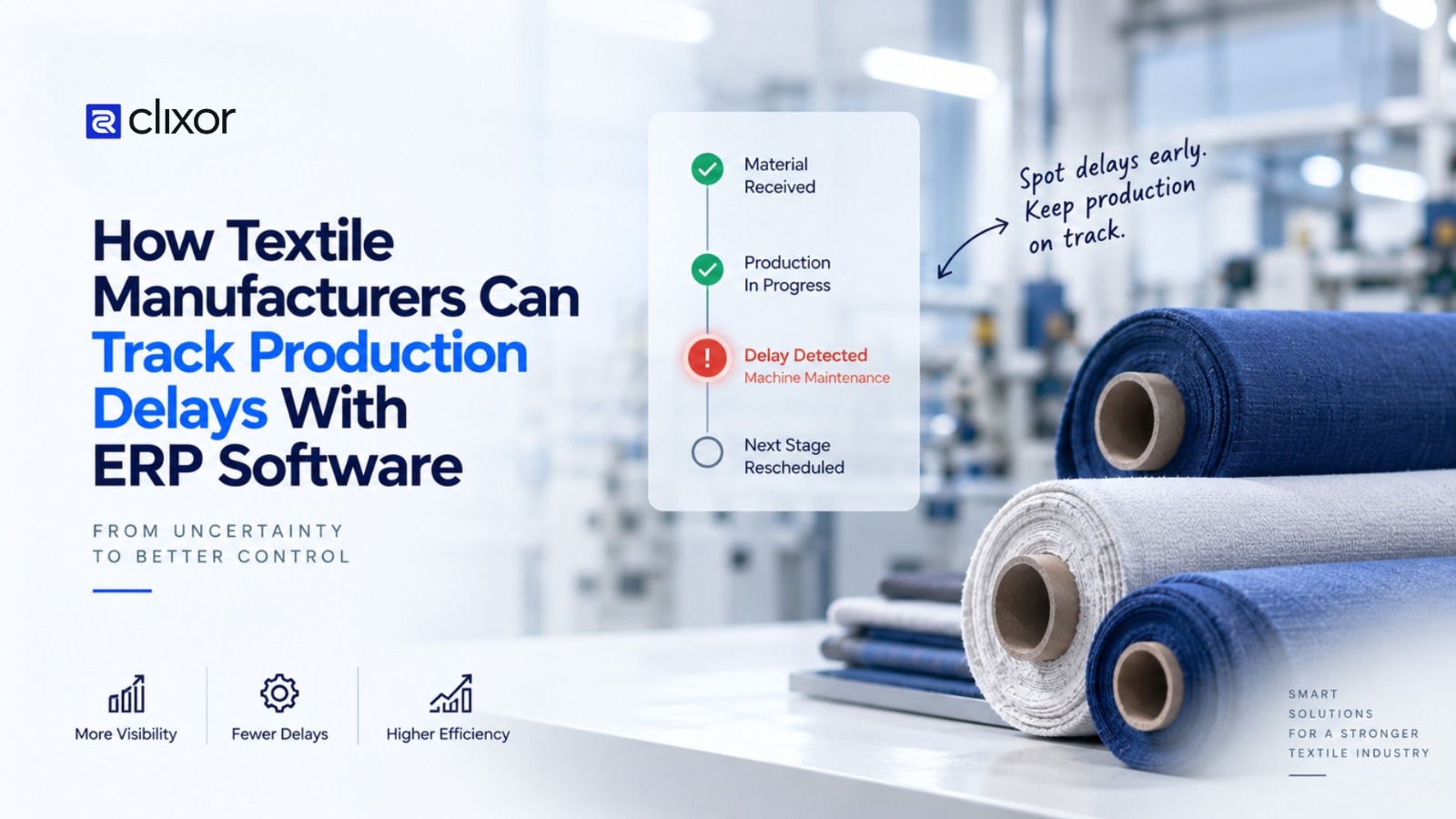
How Textile Manufacturers Can Track Production Delays With ERP Software
Production delays can affect schedules, customer commitments, labour planning, and overall manufacturing efficiency. For textile manufacturers, identifying the cause of a delay can be difficult when production information is spread across spreadsheets, paper records, messages, and separate systems.
An ERP system brings key production information into one place. By connecting production planning, material availability, machine activity, inventory, and order information, textile businesses can track production delays with ERP software and understand where a process is slowing down.
- Why Are Production Delays Difficult to Track?
- How ERP Software Helps Track Production Delays
- What Should Textile Manufacturers Track?
- Benefits of Better Production Delay Tracking
- 5 FAQs About Tracking Textile Production Delays
- Conclusion
Why Are Production Delays Difficult to Track?
Textile manufacturing involves several connected stages. Depending on the business, these may include order planning, raw material procurement, yarn processing, weaving or knitting, dyeing, finishing, quality checking, packing, and dispatch.
A delay in one stage can affect the stages that follow.
For example, if dyed fabric is not completed on schedule, finishing may have to wait. Without clear production data, management may only discover the problem when the delivery date is already approaching.
How ERP Software Helps Track Production Delays
1. Monitor Each Production Stage
A textile ERP system can record the progress of different production activities. Managers can check whether a job is planned, in progress, completed, or delayed.
This makes it easier to identify which stage needs attention instead of checking with different teams individually.
2. Identify Production Bottlenecks
ERP software can help businesses compare planned production schedules with actual progress.
If a particular process repeatedly takes longer than expected, management can investigate the reason. The issue could be machine availability, labour allocation, material shortages, rework, or scheduling problems.
Finding the bottleneck is an important step toward reducing production delays.
3. Check Material Availability
Production cannot continue smoothly when required materials are unavailable.
A textile ERP system can connect production planning with inventory information. Teams can check whether yarn, fabric, dyes, accessories, or other required materials are available before production begins.
This helps reduce delays caused by unexpected material shortages.
4. Track Machine and Work Order Status
Machine-related issues can affect production schedules. ERP software can help teams record machine status, maintenance requirements, and work order progress.
For example, if a machine is unavailable, the production team can identify affected orders and adjust the schedule instead of discovering the delay later.
5. Compare Planned and Actual Production
One useful feature of ERP software is the ability to compare what was planned with what was actually completed.
If an order was planned for completion on Friday but remains incomplete, managers can quickly review its current status and determine where the delay occurred.
This creates better visibility into production performance.
What Should Textile Manufacturers Track?
To understand production delays, businesses should monitor information such as:
- Planned and actual production times
- Work order status
- Machine availability
- Material availability
- Labour allocation
- Rework and quality issues
- Production quantities
- Pending operations
- Order delivery schedules
Tracking these details helps management identify patterns rather than reacting to individual delays.
Benefits of Better Production Delay Tracking
When textile manufacturers have clearer production visibility, they can respond to problems earlier. Teams can adjust schedules, allocate resources, arrange materials, or address machine issues before a small delay becomes a larger production problem.
ERP software can also improve communication between production, inventory, purchasing, and management teams because everyone can work with more consistent information.
5 FAQs About Tracking Textile Production Delays
1. Can ERP software track production delays?
Yes. ERP software can track work orders, production stages, planned schedules, actual progress, materials, and other information that helps identify delays.
2. What causes production delays in textile manufacturing?
Common causes include material shortages, machine problems, labour availability, quality issues, rework, and production scheduling problems.
3. Can textile ERP software track machine-related delays?
Yes. Depending on the system, machine status, maintenance activities, and production work orders can be recorded and monitored.
4. How does ERP help reduce textile production delays?
ERP provides better visibility into production activities, helping teams identify bottlenecks and respond to material, machine, scheduling, or workflow issues earlier.
5. Is ERP software useful for small textile manufacturers?
Yes. The right ERP solution can help smaller manufacturers organize production, inventory, orders, and workflows without relying heavily on disconnected manual records.
Conclusion
Production delays are easier to manage when manufacturers can see where and why they happen. By connecting production planning, inventory, work orders, machine information, and order schedules, ERP software can help textile businesses track production delays more effectively.
For textile manufacturers looking to improve production visibility, a solution should be designed around their actual manufacturing workflow. Clixor Technologies develops ERP solutions tailored to specific textile business and production requirements.