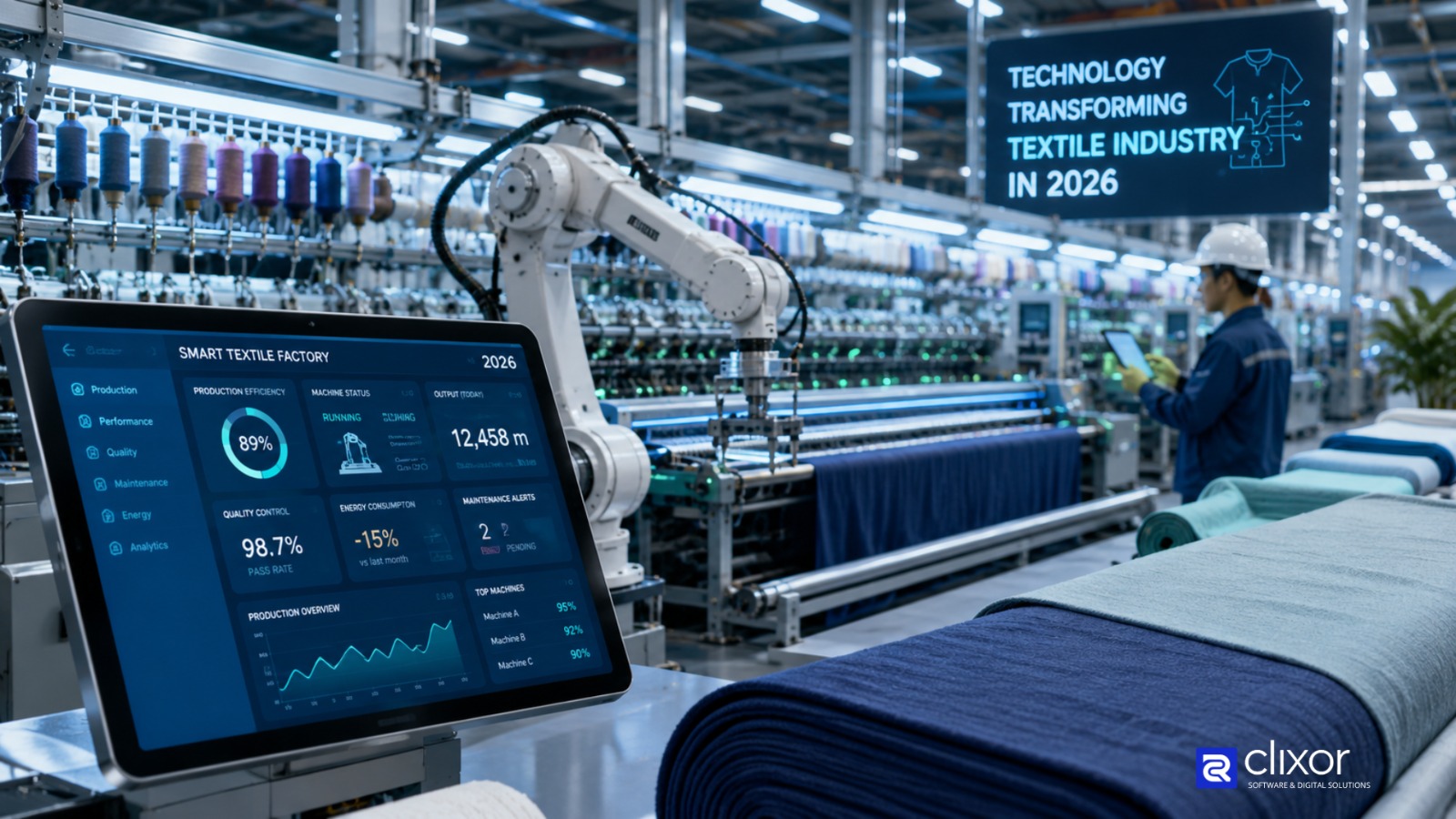
How Technology Is Transforming the Textile Industry in 2026
- Introduction
- How Is Technology Changing the Textile Industry?
- How Is AI Used in Textile Manufacturing?
- How Does Automation Improve Textile Production?
- How Is IoT Used in Textile Manufacturing?
- How Does Cloud Software Help Textile Businesses?
- How Can Data Analytics Improve Textile Business Decisions?
- How Can Technology Help Reduce Textile Waste?
- How Is Technology Improving Textile Supply Chains?
- Why Should Textile Companies Invest in Custom Software?
- What Should Textile Companies Consider Before Adopting Technology?
- Conclusion
Introduction
The textile industry is rapidly adopting technology to improve production, reduce waste, manage costs, and meet changing customer demands. In 2026, AI, automation, IoT, cloud computing, and data analytics are helping textile companies create smarter and more connected operations.
Technology is no longer limited to factory machinery. Businesses can now use digital systems to manage production, inventory, quality, orders, suppliers, and business data from connected platforms.
The key question for textile companies is not simply which technology to adopt, but which technology can solve their specific business challenges. The right solution can improve efficiency, visibility, and decision-making.
How Is Technology Changing the Textile Industry?
Traditional textile manufacturing often depends on manual processes, spreadsheets, and separate systems. This can make it difficult to track production, inventory, quality, and delays.
Modern digital systems connect these processes and provide better visibility. For example, production dashboards can show real-time progress, helping managers identify issues earlier and respond quickly to changes in demand or production capacity.
How Is AI Used in Textile Manufacturing?
AI is helping textile manufacturers analyze data, detect quality issues, and improve forecasting. Computer vision systems can identify fabric defects, color variations, stains, and other problems during quality inspection.
AI can also analyze sales history, seasonal trends, and customer demand to improve production and inventory planning. This can help businesses avoid overproduction while reducing the risk of stock shortages.
How Does Automation Improve Textile Production?
Automation can reduce repetitive manual work in processes such as cutting, sorting, packaging, inspection, and material handling. It can improve consistency, reduce human errors, and allow employees to focus on more specialized tasks.
The goal is not simply to replace workers. Combining human expertise with automation can help textile companies increase productivity while maintaining better control over production.
How Is IoT Used in Textile Manufacturing?
IoT-enabled machines and sensors can collect real-time data on equipment performance, production conditions, energy use, and machine activity.
One important application is predictive maintenance. Instead of waiting for equipment to fail, businesses can monitor machine conditions and identify potential problems early. This can reduce unexpected downtime and improve equipment availability.
IoT data can also help manufacturers understand energy consumption and production performance, supporting better decisions across the factory.
How Does Cloud Software Help Textile Businesses?
Cloud software allows textile companies to access business information from different locations through a centralized system. Production, inventory, purchasing, sales, finance, and management teams can work with updated information instead of relying on separate records.
For businesses with multiple factories, warehouses, or offices, cloud platforms can improve visibility and coordination. They can also be expanded with additional users, modules, and integrations as the company grows.
How Can Data Analytics Improve Textile Business Decisions?
Textile companies generate data from production, inventory, sales, purchasing, quality control, and machine performance. Data analytics helps turn this information into useful business insights.
Managers can identify production delays, monitor inventory, compare performance, track sales trends, and find areas where costs can be reduced. Instead of relying solely on manual reports, businesses can use real-time data to make faster, more informed decisions.
How Can Technology Help Reduce Textile Waste?
Technology can help textile manufacturers reduce waste from excess materials, defective products, overproduction, and inefficient resource usage.
Digital production monitoring can track material usage, while automated quality inspection can identify defects earlier. Demand forecasting can also help businesses produce closer to actual market requirements.
Technology does not eliminate waste on its own, but it gives businesses better data to identify problems and improve production processes.
How Is Technology Improving Textile Supply Chains?
Textile supply chains involve suppliers, manufacturers, warehouses, distributors, and customers. Managing these activities manually can make it difficult to track orders, inventory, shipments, and delays.
Digital supply chain systems provide better visibility across these processes. Connected information helps businesses identify problems earlier, manage inventory more effectively, and coordinate production with customer demand.
For companies working with multiple suppliers or international customers, this improved visibility can make supply chain management more efficient.
Why Should Textile Companies Invest in Custom Software?
Every textile business has different workflows and operational requirements. Standard software may not always fit these processes, while custom software development allows businesses to build solutions around their specific needs.
A textile manufacturer could connect production planning, inventory, quality control, purchasing, order management, and reporting through one platform. This can reduce repetitive data entry, improve visibility, and give management a clearer view of business performance.
What Should Textile Companies Consider Before Adopting Technology?
Technology adoption should begin with a clear business problem rather than simply following a trend. Companies should identify where they are losing time, money, productivity, or visibility before selecting a solution.
They should also consider system integration, employee training, data security, scalability, implementation, and maintenance. Starting with one important problem and measuring the results can be more effective than trying to digitize everything at once.
Conclusion
Technology is making the textile industry more connected, automated, and data-driven in 2026. AI, automation, IoT, cloud software, analytics, and digital supply chain solutions can help manufacturers improve efficiency and make better decisions.
For textile businesses looking to modernize their operations, Clixor Technologies can develop practical software solutions based on specific workflows and business challenges.
The real advantage of technology comes from using it to solve genuine operational problems and create more efficient, scalable textile businesses.