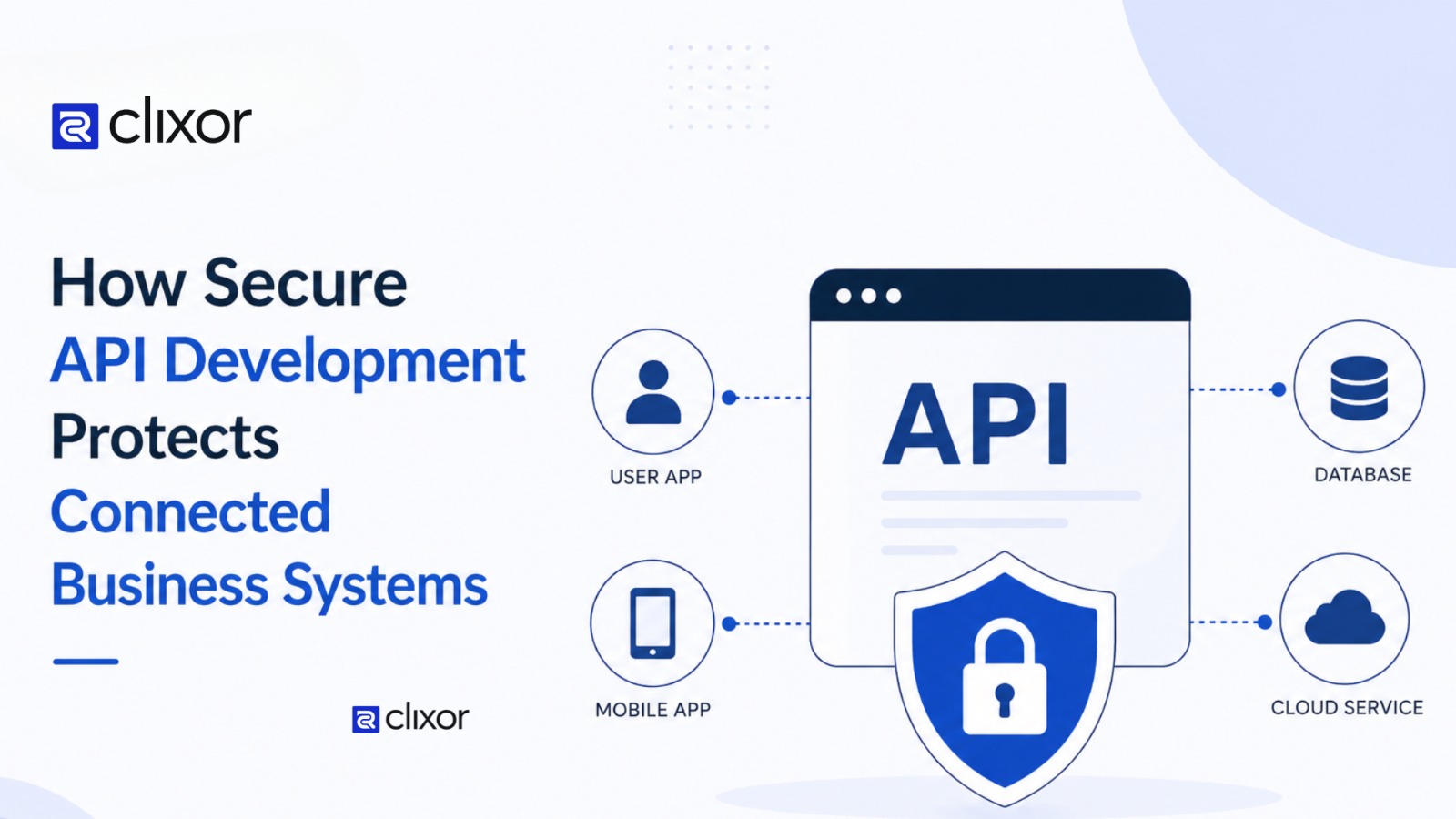
How Secure API Development Protects Connected Business Systems
Modern businesses rarely rely on a single software system. Websites, mobile applications, payment platforms, CRM tools, cloud services, and internal applications often need to communicate.
APIs make this communication possible by letting different applications exchange data and perform actions without being built as one system.
However, every API that connects systems can also create a security risk if it is not designed properly. Secure API development helps businesses protect data, control access, and reduce risks across connected applications.
- What Is API Development?
- Why API Security Matters
- Key Practices in Secure API Development
- Monitoring and Testing APIs
- Secure API Design for Growing Businesses
- Conclusion
What Is API Development?
An API, or Application Programming Interface, allows different software applications to communicate with each other.
For example, an online store may use an API to connect its website with a payment service. When a customer makes a payment, the systems exchange information through the API.
APIs are useful, but developers need to make sure that only authorized users and applications can access the resources they need.
Why API Security Matters
An insecure API can expose sensitive information or allow unauthorised actions.
Depending on the application, APIs may handle customer details, account information, payment-related data, business records, or internal system operations.
A secure API should therefore be designed with security from the beginning rather than treating it as something to add after development.
Key Practices in Secure API Development
1. Authentication
Authentication verifies who is making an API request.
Developers can use appropriate authentication mechanisms to ensure that only verified users, applications, or services can access protected endpoints.
Authentication methods should be selected according to the application's requirements and risk level.
2. Authorisation
Authentication tells the system who the user is, while authorisation determines what that user is allowed to do.
For example, an employee may be allowed to view customer records but not delete them.
Proper authorisation controls help prevent users from accessing functions or information outside their responsibilities.
3. Data Encryption
Sensitive information should be protected while it travels between systems.
Using secure communication protocols such as HTTPS helps protect API traffic from being exposed during transmission.
Businesses should also consider appropriate protection for sensitive data stored within their systems.
4. Input Validation
APIs should not automatically trust data received from users or other applications.
Developers should validate incoming data and reject requests that do not meet expected requirements.
This helps reduce the risk of unexpected input causing application problems or security issues.
5. Rate Limiting
An API can receive a large number of requests. Rate limiting controls how many requests a user or application can make within a specific period.
This can help protect API resources from excessive or abusive traffic and maintain service availability.
Monitoring and Testing APIs
Security does not end when an API is deployed.
Developers should monitor API activity and review logs for unusual requests or unexpected behaviour.
Regular security testing can also help identify weaknesses before attackers discover them.
API endpoints, authentication methods, permissions, and dependencies should be reviewed as the application changes.
Secure API Design for Growing Businesses
As businesses grow, more applications may need to connect to existing systems. This can increase the number of APIs and the amount of data moving between applications.
Developers should maintain clear documentation, consistent security policies, access controls, and monitoring across these connections.
Security should also be considered when adding third-party APIs. Businesses should understand what data is shared, what permissions are required, and how the external service handles that information.
Conclusion
Secure API development is an important part of protecting connected business systems. Authentication, authorisation, encryption, input validation, rate limiting, monitoring, and regular testing can help reduce security risks.
Businesses should think about API security from the planning stage rather than waiting until an application is already live.
For companies developing new applications or connecting existing systems, Clixor Technologies can incorporate secure API practices into software and web development projects based on business requirements.
A secure API does more than connect applications. It helps create a safer foundation for the systems that businesses depend on every day.