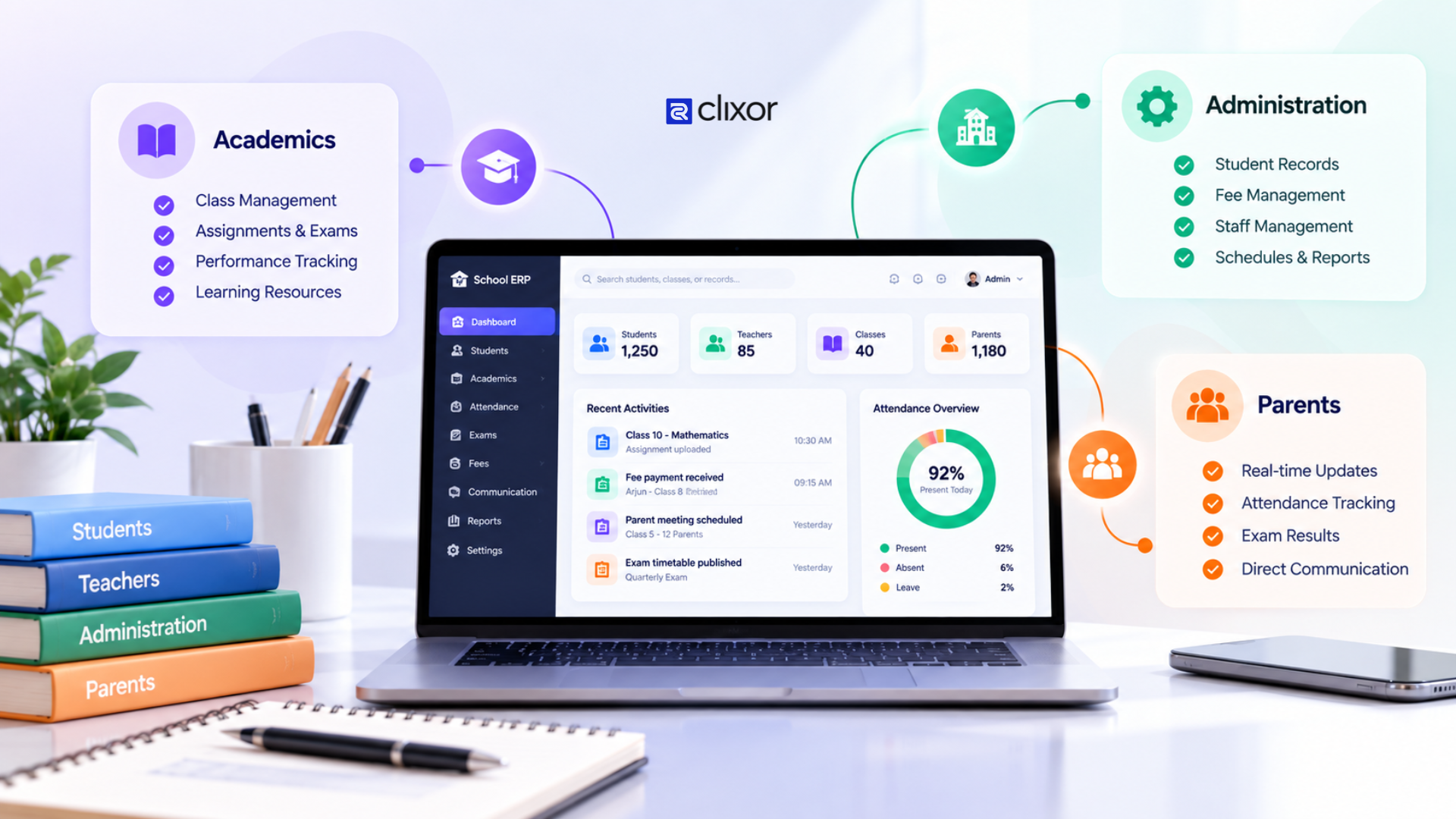
How School ERP Can Connect Academics, Administration, and Parents
A school involves much more than classroom teaching. Teachers manage academic activities, administrators handle records and operations, and parents need regular updates about their child's progress.
When these activities are managed through separate systems, information becomes hard to track and share. A School ERP brings these functions together on one connected digital platform.
Instead of managing academics, administration, and communication separately, schools can create a more organised workflow where the right information reaches the right people.
- What Is a School ERP?
- Connecting Academics and Administration
- Improving Parent Communication
- Creating One Connected School Workflow
- How School ERP Supports Better Decision-Making
- Choosing the Right School ERP
- How Clixor Tech Can Support Digital School Management
- FAQs
- Conclusion
What Is a School ERP?
A School ERP is a digital system designed to manage different school operations from a centralised platform.
Depending on the school's requirements, it can include features such as:
- Student and staff management
- Attendance tracking
- Academic records
- Examination management
- Fee management
- Timetable management
- Parent communication
- Reports and notifications
The main purpose is not simply to digitise individual tasks. It is to connect them so that different departments can work with relevant information more efficiently.
Connecting Academics and Administration
Academic activities often depend on administrative data.
For example, attendance records can support academic monitoring, while examination data can help administrators generate reports. When information is maintained in separate files or systems, staff may need to enter the same information multiple times.
A School ERP can connect these processes through custom application development designed around the school's workflows.
Managing Student Information
Student profiles can contain important academic and administrative information in one place. Authorised staff can access relevant records without searching through multiple spreadsheets or physical documents.
Connecting Attendance and Academics
Attendance information can be recorded digitally and connected with student records. Teachers and administrators can use this information when reviewing attendance patterns or preparing reports.
Simplifying Examination Management
Exam schedules, marks, grades, and academic reports can be managed through a centralised system. This can reduce repetitive data entry and make academic information easier to organise.
Improving Parent Communication
Parents need more than occasional updates during meetings.
A connected school management system can provide parents with access to relevant information such as attendance, examination results, announcements, schedules, and fee-related updates.
For example, when a teacher records attendance, the information can become available through the appropriate parent-facing system without requiring separate manual communication.
This creates a clearer connection between the school and home.
Creating One Connected School Workflow
The real value of a School ERP comes from connecting different activities.
Consider a simple example:
Teacher records attendance → Student record is updated → Administration can view relevant data → Parent receives an appropriate update.
Instead of each department handling the same information separately, the workflow can move through one connected system.
This can help reduce duplicate work and make information easier to track.
How School ERP Supports Better Decision-Making
School administrators regularly need information to understand what is happening across the institution.
A centralised system can help organise data into reports related to attendance, academics, fees, student records, and other operational areas.
Having information in a structured format can make it easier for school management to identify areas that require attention and make informed decisions. This is also a key purpose of Educational Management Information Systems (EMIS), which UNESCO describes as systems that integrate education data to support decision-making, planning, monitoring, and management.
Choosing the Right School ERP
Not every school has the same requirements. Before choosing school ERP software, institutions should consider:
- Ease of use for teachers and administrators
- Parent and student accessibility
- Data security and user permissions
- Integration with existing systems
- Reporting capabilities
- Scalability as the school grows
- Mobile accessibility
The system should solve actual operational problems rather than simply provide a long list of features.
Schools should also consider how student data privacy is managed when schools use digital systems and third-party educational services.
How Clixor Tech Can Support Digital School Management
Clixor Technologies focuses on building digital solutions around specific business and organisational requirements.
For educational institutions, a well-planned school management platform can bring different workflows together while keeping the experience simple for administrators, teachers, students, and parents.
The objective should be practical: reduce unnecessary manual work, organise information, and create better digital communication across the school.
FAQs
1. What is a School ERP?
A School ERP is software that helps schools manage academic, administrative, financial, and communication activities through a centralised system.
2. How does School ERP help parents?
It can give parents access to relevant updates such as attendance, academic results, announcements, schedules, and other school information.
3. Can School ERP connect teachers and administrators?
Yes. A centralised ERP can allow authorised teachers and administrators to access and update relevant information within connected workflows.
4. What features should a School ERP include?
Common features include student management, attendance, examinations, fees, timetables, communication, reports, and user management.
5. Is School ERP useful for growing schools?
A suitable ERP can help growing schools organise increasing amounts of student, academic, and administrative information through a centralised system.
Conclusion
A modern school needs more than individual digital tools. It needs systems that can communicate with each other and support connected school management.
A School ERP can connect academics, administration, teachers, students, and parents through a more organised digital workflow. When information moves smoothly between the people who need it, everyday school management can become easier to track and manage. This makes the system a practical way to support better coordination across the school.
The goal of technology in education is not to replace the people running the school. It is to give them better systems to work with.