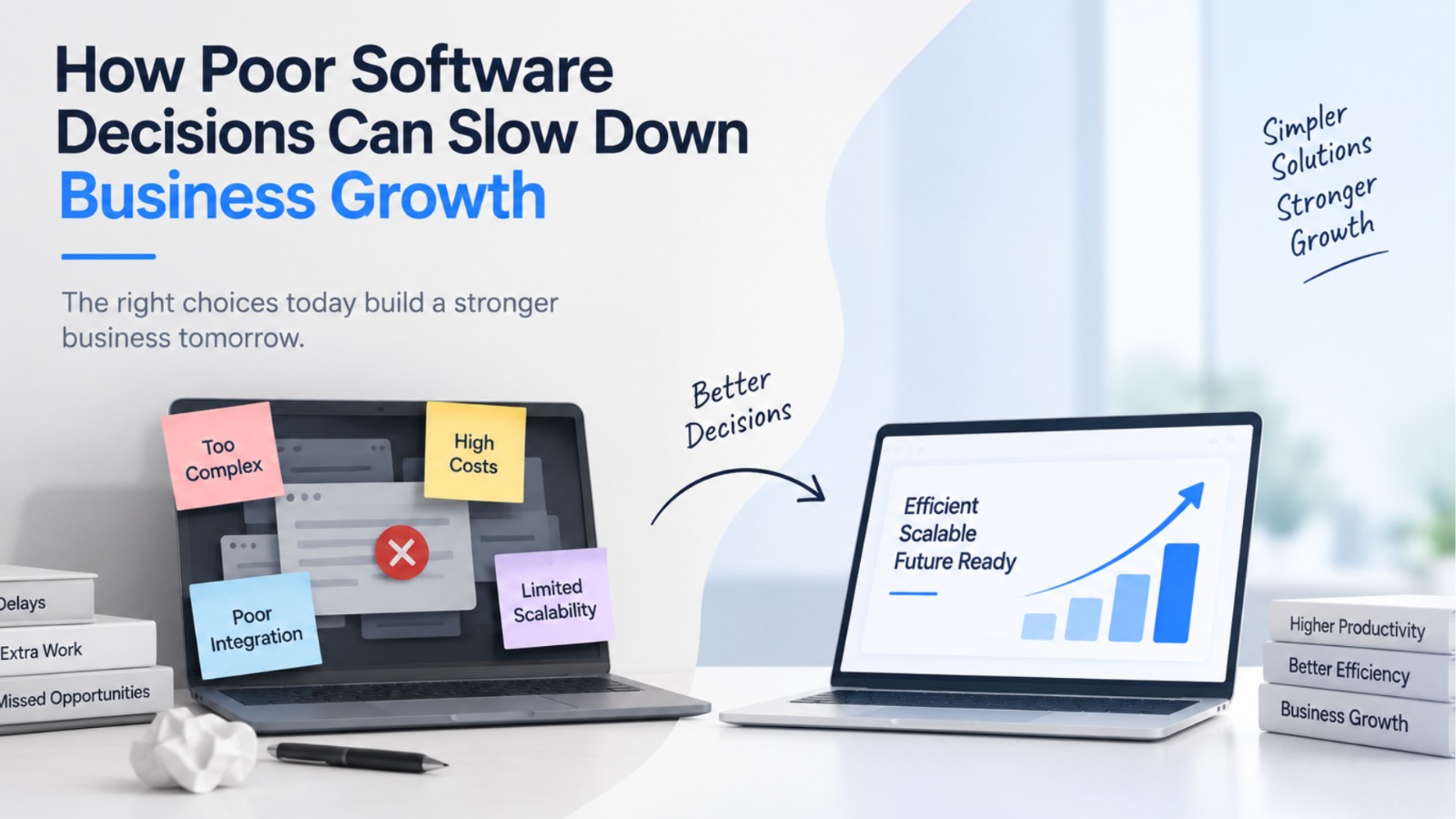
How Poor Software Decisions Can Slow Down Business Growth
Choosing software is an important business decision. The right system can help employees work faster, improve customer service, reduce manual tasks, and support future growth. But a poor software decision can have the opposite effect.
Businesses may select a system because it is inexpensive, popular, or quick to implement without considering whether it actually fits their operations. As the business grows, those early decisions can create workflow problems, higher costs, and technical limitations.
Understanding the impact of poor software decisions can help businesses make better technology choices from the beginning.
- How Poor Software Decisions Affect Business Growth
- How Can Businesses Make Better Software Decisions?
- 5 FAQs About Poor Software Decisions
- Conclusion
How Poor Software Decisions Affect Business Growth
Software problems do not always appear immediately. A system may work well when a business is small but become difficult to manage as the number of users, customers, transactions, or processes increases.
Here are some common ways poor software decisions can affect growth.
1. Software May Not Match Business Processes
Every business has its own way of handling customers, approvals, sales, operations, and reporting. If software does not support these workflows, employees may create manual workarounds.
For example, a sales team may have to export information from one application and enter it into another system just to complete a routine task.
The software is being used, but it is not actually making the process simpler.
2. Disconnected Systems Create Extra Work
Businesses often use separate tools for accounting, customer management, communication, inventory, marketing, and operations.
When these systems do not integrate properly, employees may repeatedly enter or transfer the same information. This takes time and can introduce data errors.
Good software decisions should consider not only what a system can do independently, but also how well it can work with other business systems. API development and integration can help businesses connect applications and reduce unnecessary manual data transfers. AWS application integration also explains how connected applications can support business workflows.
3. Short-Term Savings Can Create Long-Term Costs
Choosing the cheapest option may appear financially sensible, but the initial price does not show the complete cost of ownership.
Businesses may later spend more on custom modifications, integrations, migrations, training, maintenance, or replacing the system completely.
A better approach is to consider the software's long-term value rather than only its initial cost.
4. Limited Scalability Can Restrict Growth
Software should be able to support changing business requirements.
If a system cannot handle additional users, larger data volumes, new integrations, or more complex workflows, the business may eventually outgrow it.
Replacing an important system while the business is expanding can also create unnecessary disruption. AWS guidance on scalable and resilient applications provides useful principles for considering scalability as systems grow.
5. Difficult Maintenance Can Slow Teams Down
Software that is poorly designed or difficult to maintain can make even small changes complicated.
Developers may spend more time fixing existing issues instead of improving the product. Businesses may also become dependent on outdated technologies or systems that are difficult to modify.
How Can Businesses Make Better Software Decisions?
Businesses can reduce these risks by evaluating software based on actual requirements.
Start by identifying the current problems, important workflows, expected future needs, integration requirements, security considerations, and maintenance expectations.
It is also useful to involve the people who will actually use the software. Employees often understand workflow problems that may not be visible to management.
Before selecting or developing a solution, businesses should ask:
- Does the software solve the actual business problem?
- Can it integrate with existing systems?
- Can it support future growth?
- Is it easy to maintain and update?
- What will the total cost be over time?
When existing products cannot meet important requirements, custom software development may provide greater flexibility and control. Businesses can also consider OWASP security verification practices when evaluating security requirements for software applications.
5 FAQs About Poor Software Decisions
1. What are poor software decisions?
Poor software decisions happen when businesses choose, develop, or implement software without properly considering their requirements, workflows, integrations, scalability, or long-term costs.
2. Can software affect business growth?
Yes. Software influences productivity, workflows, customer service, data management, and operational efficiency. The wrong system can create limitations as the business grows.
3. Is cheaper software always a better choice?
No. A lower initial price does not always mean lower overall cost. Maintenance, integrations, upgrades, training, and future replacement should also be considered.
4. When should a business consider custom software?
Custom software may be suitable when existing solutions cannot support important business processes, integrations, or specific operational requirements.
5. How can businesses avoid software-related problems?
Businesses should clearly define requirements, evaluate long-term needs, involve users, check integration options, and consider scalability and maintenance before making a software decision. When these steps are followed, software choices are more likely to support business growth and avoid common problems.
Businesses should clearly define requirements, evaluate long-term needs, involve users, check integration options, and consider scalability and maintenance before making a software decision.
Conclusion
Software should support business growth, not become a limitation. Poor software decisions can lead to inefficient workflows, disconnected systems, increasing costs, and difficult maintenance.
The best approach is to look beyond features and price. Businesses should choose technology based on their current processes, future requirements, integration needs, and long-term goals.
Clixor Technologies helps businesses plan and develop software solutions around their operational requirements, with a focus on practical systems that support business needs as they evolve.