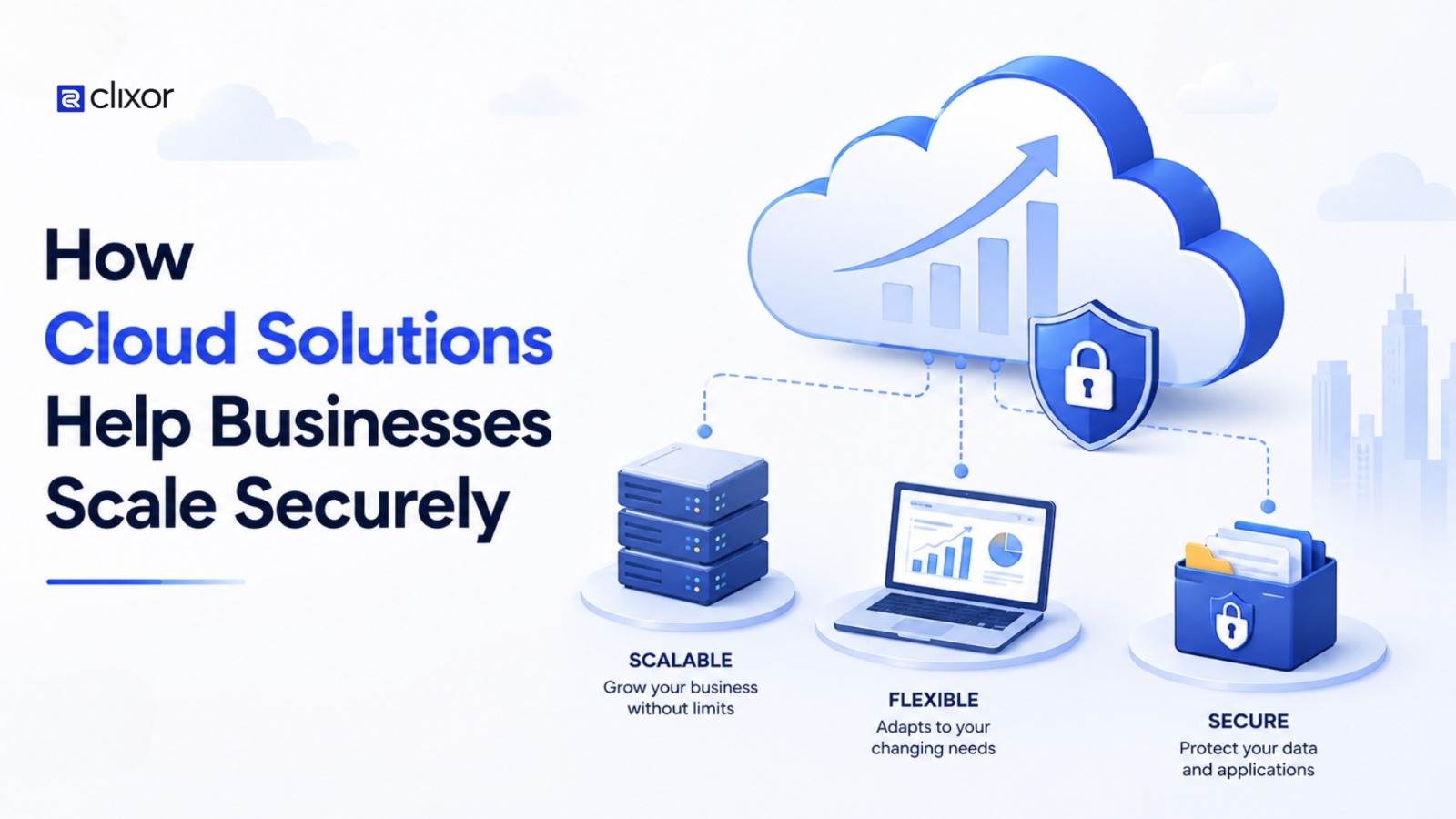
How Cloud Solutions Help Businesses Scale Securely
Businesses need technology that can grow with them. As customer demand increases, companies often need more storage, computing power, applications, and dependable systems. Traditional IT infrastructure can make this growth costly and difficult to manage.
Cloud solutions for businesses offer a flexible way to scale resources as needed while supporting security, reliability, and efficient IT management. From startups to established companies, cloud technology can help organizations expand without continually investing in physical infrastructure.
But how can businesses scale while keeping their data and systems secure? Let’s explore the key benefits.
- What Are Cloud Solutions for Businesses?
- How Cloud Solutions Help Businesses Scale
- How Cloud Solutions Support Business Security
- Choosing the Right Cloud Strategy
- Why Secure Scalability Matters
- Conclusion
What Are Cloud Solutions for Businesses?
Cloud solutions let businesses access computing resources such as storage, servers, databases, applications, and networking through cloud platforms, rather than relying entirely on physical infrastructure.
Instead of purchasing additional servers whenever the business grows, a company can adjust its cloud resources according to its requirements.
For example, an online store may experience higher traffic during a seasonal sale. A scalable cloud environment can add resources to handle increased demand and scale back when traffic returns to normal.
How Cloud Solutions Help Businesses Scale
1. Flexible Resources
One of the biggest advantages of cloud computing is flexibility. Businesses can scale resources up or down based on their workload.
This is useful for companies with changing customer demand, seasonal operations, or rapidly growing digital services.
2. Lower Infrastructure Requirements
Maintaining physical servers requires space, hardware, maintenance, and technical resources. Cloud infrastructure reduces the need for businesses to manage all of these components themselves.
Organizations can focus more on their applications and business operations while the cloud environment handles much of the underlying infrastructure.
3. Better Business Continuity
Unexpected hardware failures, system problems, or other disruptions can affect business operations. Cloud environments can support backup, redundancy, and recovery strategies that help organizations prepare for such situations.
A well-designed cloud strategy can therefore make it easier to maintain access to important applications and data.
How Cloud Solutions Support Business Security
Scaling a business is not only about adding resources. Security must also remain a priority as the amount of data and number of users increase.
Access Control
Businesses can use identity and access management to control who can access applications, systems, and sensitive information.
Employees should receive only the permissions they need to perform their roles. This helps reduce unnecessary access to important resources.
Data Protection
Cloud security can include encryption, secure authentication, backups, monitoring, and other security controls. Businesses should select security measures based on their data, applications, industry requirements, and risk profile.
Continuous Monitoring
Monitoring cloud environments can help organizations identify unusual activity, configuration issues, and potential security problems.
Regular reviews are important because cloud environments can change quickly as new users, applications, and resources are added.
Choosing the Right Cloud Strategy
Not every business needs the same cloud setup. Companies should first understand their workloads, security requirements, budget, compliance needs, and growth plans.
A suitable strategy may involve public cloud, private cloud, hybrid cloud, or a combination of different services.
Businesses should also consider:
- Data security requirements
- Backup and recovery needs
- Application performance
- Access management
- Integration with existing systems
- Future scalability
- Ongoing management costs
A well-planned approach can prevent businesses from moving workloads to the cloud without considering their actual requirements.
Why Secure Scalability Matters
Growth often introduces new challenges. More customers can mean more users, transactions, data, and applications. Without a scalable infrastructure, performance problems and security gaps can become harder to manage.
Cloud solutions for businesses can provide the flexibility needed for growth while allowing organizations to build security controls into their infrastructure.
For companies planning cloud adoption or improving an existing environment, Clixor Technologies can help evaluate technology requirements and develop solutions that support business goals without treating security as an afterthought.
Conclusion
Cloud technology can give businesses the flexibility to grow without depending entirely on traditional physical infrastructure. With scalable resources, centralized management, backup strategies, access controls, and security monitoring, cloud solutions can support both business growth and operational resilience. In the end, the right cloud approach helps businesses scale securely while staying prepared for change.
The key is choosing the right cloud architecture and implementing it carefully. Secure scalability is not simply about moving systems to the cloud—it is about building an environment that can adapt as the business grows and continue supporting security along the way.