How Caching Strategies Improve Business Application Performance
Business applications must respond quickly, especially when employees and customers rely on them throughout the day. Slow page loads, delayed API responses, and repeated database queries can affect productivity and user experience.
One practical way to speed up applications is caching. By temporarily storing frequently used data, caching strategies can reduce unnecessary processing and help applications deliver information faster.
- What Is Caching in Business Applications?
- How Caching Strategies Improve Business Application Performance
- Common Caching Strategies
- What Should Businesses Cache?
- What Are the Challenges of Caching?
- How Clixor Tech Can Help
- FAQs
- Conclusion
What Is Caching in Business Applications?
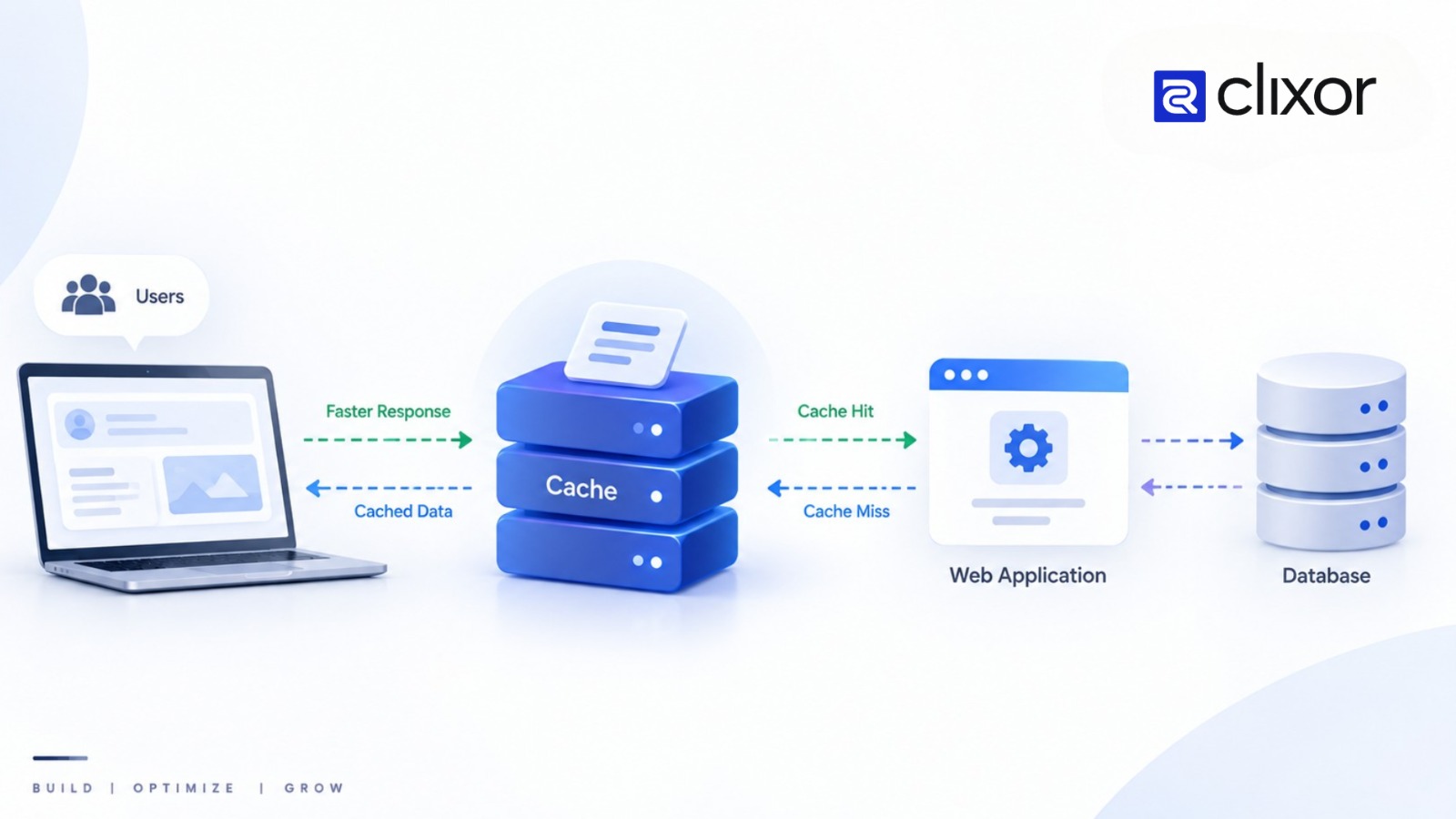
Caching is a technique where frequently requested data is stored in a temporary storage layer. When the application needs the same information again, it can retrieve it from the cache instead of processing the original request from scratch.
For example, an e-commerce application may repeatedly receive requests for product categories. Instead of querying the database every time, the application can cache commonly accessed category information and serve it faster.
This reduces repeated database operations and can improve overall application performance.
How Caching Strategies Improve Business Application Performance
1. Faster Response Times
Caching allows applications to retrieve frequently requested information from a faster storage layer. This can reduce the time users spend waiting for pages, dashboards, or API responses.
For business applications, faster response times can make everyday tasks smoother and more efficient.
2. Reduces Database Load
Databases can become a performance bottleneck when an application receives many repeated requests.
Caching frequently accessed information reduces the number of database queries. This allows the database to focus on operations that actually require fresh data.
For example, a business dashboard showing the same general statistics to hundreds of users may benefit from caching those results for a short period.
3. Handles Higher User Traffic
As a business grows, its application may need to handle more users and requests. Caching can help manage this increased demand by reducing repeated processing.
Instead of generating the same response for every request, the application can reuse cached results when appropriate.
4. Improves API Performance
Modern business applications often depend on APIs to exchange data between services. Repeated API requests can increase processing time and server workload.
Caching API responses that do not change frequently can reduce unnecessary requests and provide faster responses to users.
Businesses planning applications that depend heavily on connected services can also consider API development and integration when designing efficient communication between application components.
5. Supports Better Scalability
Caching can become an important part of an application’s scalability strategy. When frequently requested data is served from a cache, application servers and databases may have more capacity for other operations.
However, caching should support the application’s architecture rather than being added without planning.
For businesses developing applications that need to support growing workloads, cloud solutions can provide infrastructure that supports different performance and scaling requirements.
Common Caching Strategies
Different applications require different caching approaches.
Browser caching stores certain resources on the user’s device, helping repeat visits load static content faster. The MDN guide to HTTP caching explains how browsers and HTTP caches can store and reuse responses.
Application caching stores frequently used data within the application layer.
Database caching reduces repeated database operations for commonly requested information.
API caching stores responses from APIs that do not need to be generated for every request.
CDN caching stores static content closer to users, which can help reduce loading time for websites and web applications. Cloudflare's caching documentation provides guidance on how cached content can be delivered through a CDN.
What Should Businesses Cache?
Not every piece of information should be cached. Good candidates usually include:
- Frequently accessed product or service information.
- Public configuration data
- Static website resources
- Search results that do not change frequently
- API responses with predictable update intervals
- Frequently viewed dashboard information.
Sensitive or frequently changing information requires more careful handling.
What Are the Challenges of Caching?
Caching improves performance, but it also introduces another layer of application management.
The biggest challenge is stale data. If cached information is not updated correctly, users may see older information.
Developers therefore need to decide when cached data should expire, when it should be refreshed, and which information should never be cached.
A well-designed caching strategy should balance speed, accuracy, storage, and complexity.
For larger applications, dedicated caching services can also be considered. Amazon ElastiCache provides managed in-memory caching capabilities that can be used to reduce latency and database workload in suitable architectures.
How Clixor Tech Can Help
For businesses building or improving web applications, performance should be considered from the beginning of the development process.
Clixor Technologies can help businesses evaluate application architecture, database performance, API behaviour, and caching requirements as part of a broader software development strategy.
The goal is not simply to add caching, but to use it where it provides meaningful performance improvements.
Businesses requiring application architecture designed around specific performance requirements can also explore custom application development.
FAQs
1. What is caching in application development?
Caching stores frequently requested information temporarily so an application can retrieve it faster without repeating the same processing.
2. Does caching always improve performance?
Caching can improve response times by reducing repeated database queries, API requests, and other processing tasks.
3. What data should be cached?
Frequently accessed and relatively stable information is generally suitable for caching. Sensitive or rapidly changing data requires additional consideration.
4. Can caching reduce database load?
Yes. When frequently requested information is served from a cache, the application may need to make fewer repeated requests to the database.
5. Is caching useful for small businesses?
Yes. Even smaller applications can benefit from caching when they have repeated requests or performance-sensitive features. The approach should match the application’s actual needs.
Conclusion
Caching is a practical technique for improving business application performance. By storing frequently requested information and reducing unnecessary processing, it can help applications respond faster, handle repeated requests more efficiently, and reduce pressure on databases and servers. In short, caching helps businesses improve speed, efficiency, and scalability when it is used strategically. A strong caching strategy supports better performance, but it works best when matched to the application’s specific needs.
The key is to use caching strategically. Businesses should identify which data is frequently accessed, determine how often it changes, and choose an appropriate caching approach. When designed correctly, caching can become an important part of building faster and more scalable business applications. The best results come from matching the caching strategy to the application’s needs and using it with clear planning.