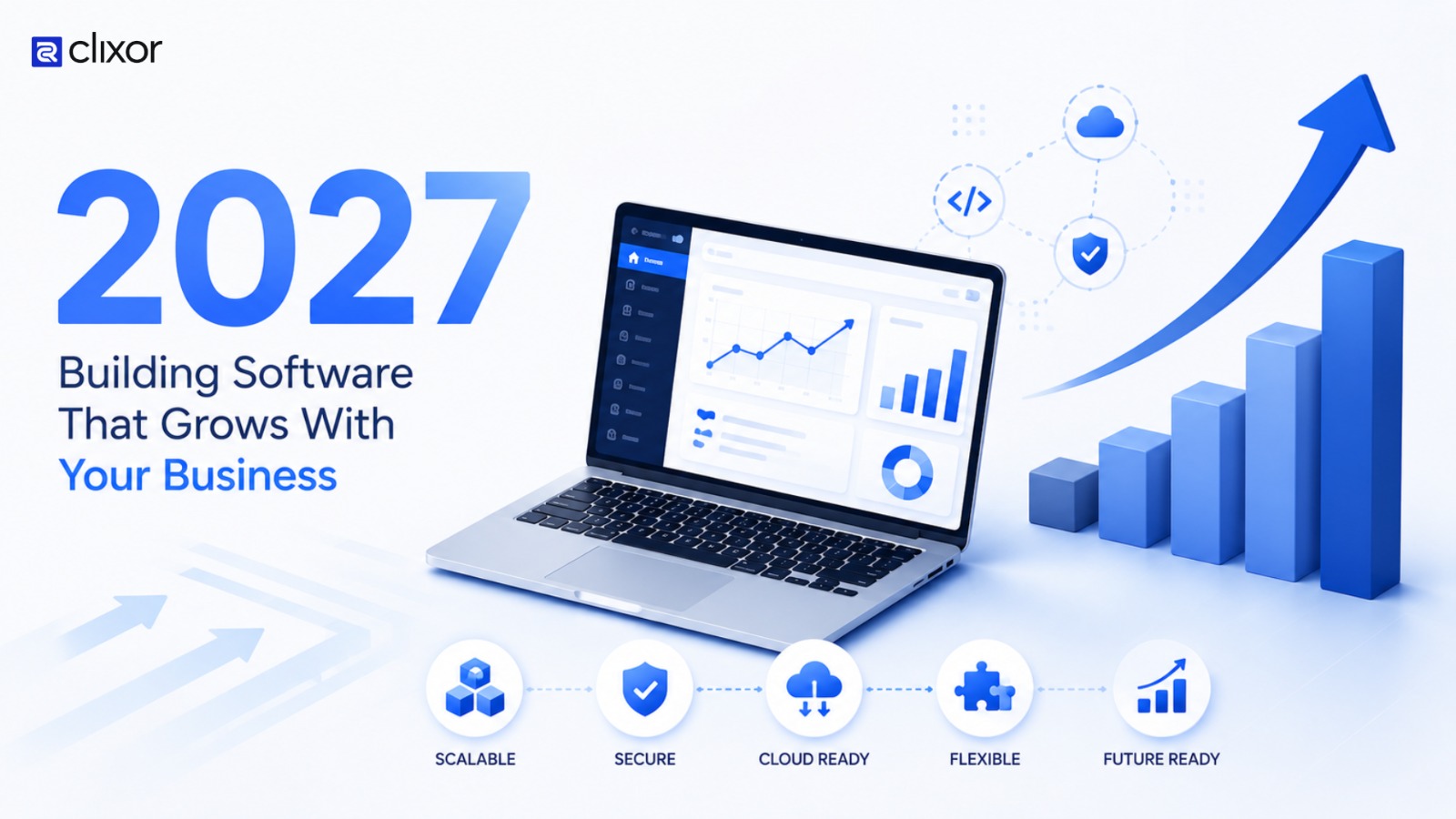
Building Software That Grows With Your Business: A 2027 Approach
- What Makes Software Scalable?
- Start With Business Requirements
- Build for Flexibility
- Plan for Users and Data Growth
- Make Integrations Easier
- Use Automation and AI Where They Add Value
- Build in Stages
- Conclusion
Building software that grows with your business means creating a system that can handle more users, customers, data, features, and business operations as the company expands without requiring a complete rebuild. In 2027, businesses need software that is not only functional today but also flexible enough to adapt to future requirements.
As a business grows, its technology needs usually change. A simple application may eventually need more users, integrations, automation, advanced reporting, better security, or new customer features. If the original software was not designed with growth in mind, adding these requirements can become expensive and difficult.
What Makes Software Scalable?
Scalable software is designed to support increasing business demands while maintaining reliable performance. This includes handling more users and data, adding new features, and connecting with other applications without affecting the entire system.
Scalability does not mean building every possible feature from the beginning. It means creating a flexible foundation that can be expanded when the business actually needs it.
Start With Business Requirements
Good software development starts with understanding the business problem rather than simply choosing a technology.
Businesses should consider which processes take the most time, where employees perform repetitive work, what customers need, and which requirements may increase as the company grows. This helps developers create software that supports both current operations and future expansion.
Build for Flexibility
Business requirements can change quickly. New services, customers, employees, and market conditions can create new software requirements.
A flexible architecture makes it easier to add or modify features without affecting the entire application. Modular development, reusable components, APIs, clean code, testing, and proper documentation can make future changes easier and more cost-effective.
Plan for Users and Data Growth
More customers usually mean more users and more data. Software that works well with a small database may experience performance issues as usage increases.
Database structure, API performance, caching, infrastructure, security, and monitoring should therefore be considered during development. A scalable system should be able to handle growth while maintaining a reliable user experience.
Make Integrations Easier
Modern businesses often use multiple systems, including CRM, accounting, payment, communication, analytics, and marketing platforms. Connecting these systems can reduce manual data entry and improve workflow efficiency.
Well-designed APIs and integrations enable business software to communicate with other applications as needed. This gives the company more flexibility as its technology needs evolve.
Use Automation and AI Where They Add Value
As a business grows, repetitive work grows too. Automation can handle suitable tasks such as lead assignment, notifications, approvals, record updates, and reporting, allowing employees to focus on work that requires human judgement.
AI can also become part of future-ready software. Depending on the business, it can support customer service, document processing, data analysis, search, recommendations, and business insights. However, AI should solve a real business problem rather than simply be added because it is trending.
Build in Stages
Businesses do not need to develop a large application with every feature from day one. Starting with the most important requirements can reduce unnecessary development and make the product easier to improve.
Once real users start using the software, their feedback can help determine which features should be developed next. This allows the product to grow according to actual business needs.
Conclusion
Building software that grows with your business is about creating a flexible technology foundation that can adapt as the company changes. Scalable architecture, reliable performance, integrations, automation, security, and maintainable development all contribute to long-term software success.
For businesses planning for 2027, the goal should not be to predict every future requirement. Instead, software should be built in a way that makes future changes easier.
The best business software is not just built for where your company is today - it is built to move forward with where your business is going.