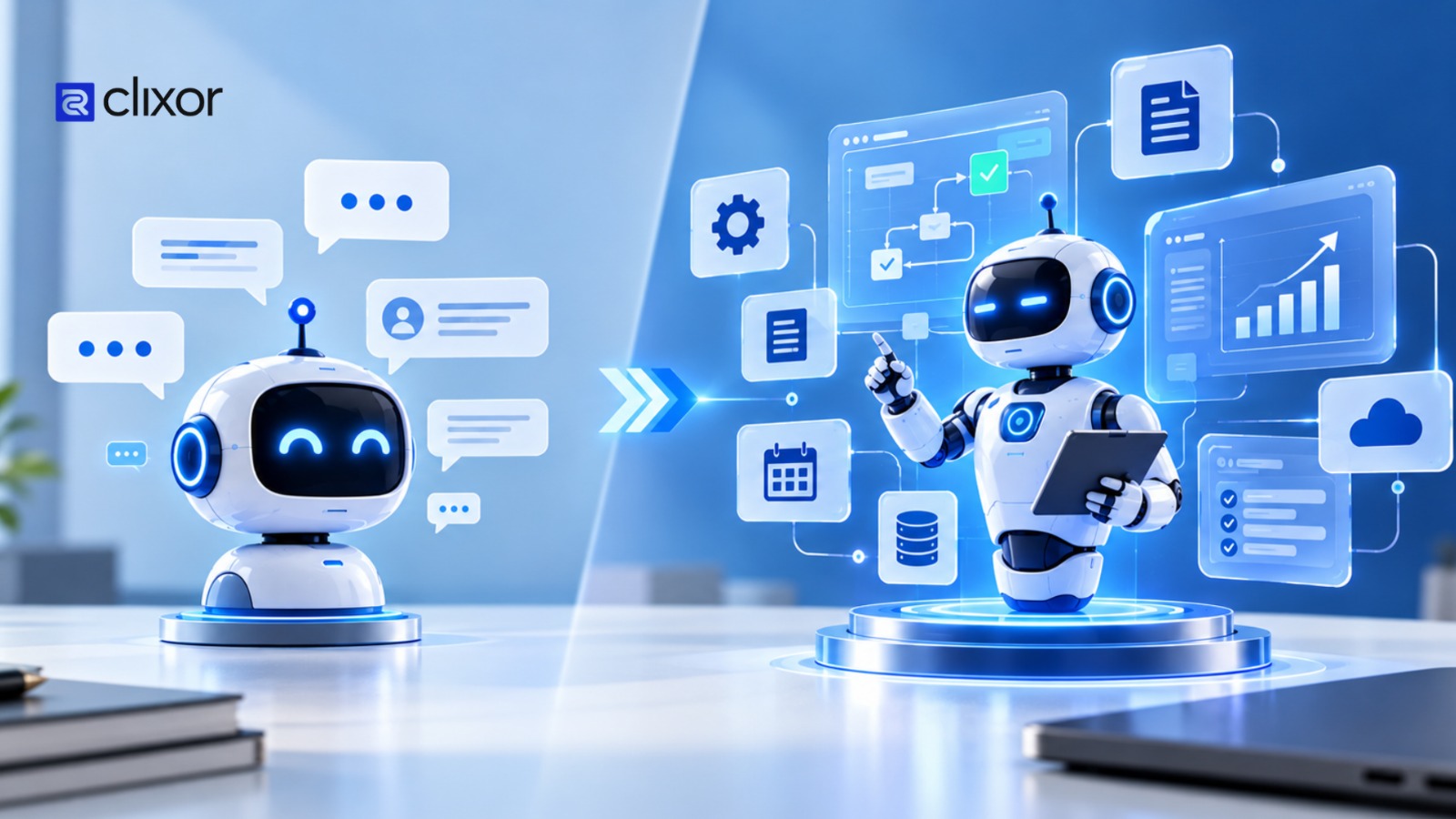
AI Agent vs AI Chatbot: What’s the Difference?
AI is becoming part of everyday business operations, especially in customer service, sales, marketing, and internal support. Two terms often come up in these conversations: AI agents and AI chatbots.
Although they may look similar, they serve different purposes.
An AI chatbot mainly focuses on communicating with users and providing responses. An AI agent can go further by understanding a goal, making decisions, using business tools, and completing multiple steps.
So, when comparing AI Agent vs AI Chatbot, what is the actual difference?
- What Is an AI Chatbot?
- What Is an AI Agent?
- AI Agent vs AI Chatbot: Key Differences
- When Should Businesses Use an AI Chatbot?
- When Should Businesses Use an AI Agent?
- Can an AI Chatbot and AI Agent Work Together?
- Frequently Asked Questions
- Conclusion
What Is an AI Chatbot?
An AI chatbot is a software system designed to communicate with users through text or voice.
Modern chatbots can understand natural language and respond to questions without requiring users to follow fixed commands.
For example, a customer might ask:
"What are your business hours?"
The chatbot can understand the question and provide the relevant information.
Businesses commonly use AI chatbots for:
- Customer FAQs
- Product information
- Basic customer support
- Appointment enquiries
- Website assistance
- Lead collection
The primary role of a chatbot is conversation and information delivery.
What Is an AI Agent?
An AI agent is designed to work toward a specific objective by performing a sequence of actions.
Instead of simply answering a question, an AI agent can interact with external systems, access information, make decisions, and complete tasks according to defined rules.
For example, if a customer asks about a delayed order, an AI agent could potentially:
- Identify the customer's order.
- Check the order management system.
- Review the shipping status.
- Identify the reason for the delay.
- Prepare an appropriate response.
- Update the relevant system if authorised.
The key difference is that an AI agent can take action, not just provide an answer.
AI Agent vs AI Chatbot: Key Differences
The easiest way to understand the difference is to look at their primary responsibilities.
| Main purpose | AI Chatbot | AI Agent |
|---|---|---|
| Communication | Yes | Yes |
| Answers questions | Yes | Yes |
| Performs actions | Limited | Can perform multiple actions |
| Uses external tools | Sometimes | Commonly |
| Handles multi-step workflows | Limited | Yes |
| Decision-making | Basic to moderate | More workflow-oriented |
| Human involvement | Often required | Can vary by task |
A chatbot is generally conversation-focused, while an AI agent is more action- and workflow-focused.
When Should Businesses Use an AI Chatbot?
AI chatbots are useful when the primary requirement is quick communication.
For example, an online store may use a chatbot to answer questions about delivery times, return policies, payment options, and product availability.
A chatbot can also act as the first point of contact before transferring a complex issue to a human employee.
For businesses that mainly need automated communication, a chatbot may be enough.
When Should Businesses Use an AI Agent?
AI agents become more useful when a business process involves several steps or different systems.
For example, a sales AI agent could receive a new enquiry, collect customer information, check a CRM integration, categorise the lead, and create a follow-up task.
This type of workflow goes beyond conversation because the system is working toward a defined business outcome.
Can an AI Chatbot and AI Agent Work Together?
Yes. Businesses do not necessarily have to choose one over the other.
A chatbot can provide the conversational interface, while an AI agent can handle tasks behind the conversation.
For example, a customer could communicate with a chatbot on a website. When the request requires an action, the chatbot could connect to an AI agent that accesses the appropriate business system.
This creates a more connected customer experience and can be supported through custom application development when businesses need AI capabilities integrated into existing workflows.
Frequently Asked Questions
1. What is the main difference between an AI agent and an AI chatbot?
An AI chatbot mainly communicates with users, while an AI agent can work through multiple steps and perform actions to achieve a specific goal.
2. Is an AI agent better than a chatbot?
They serve different purposes. A chatbot may be suitable for answering questions, while an AI agent can be useful for more complex, action-based workflows.
3. Can an AI chatbot perform actions?
Some advanced chatbots can perform actions through integrations, but their capabilities depend on how they are designed and connected to other systems.
4. Can AI agents be used for customer service?
Yes. AI agents can support customer service by accessing information, handling certain workflows, and assisting with tasks that go beyond basic conversations. AWS workflow orchestration guidance describes how agents can coordinate workflows and interact with humans and other systems.
5. Do businesses need both an AI chatbot and an AI agent?
Not always. The right solution depends on the business process. Some companies may need only a chatbot, while others may benefit from combining conversational AI with agent-based automation.
Conclusion
The difference between an AI Agent vs AI Chatbot mainly comes down to what the system is expected to accomplish.
An AI chatbot is primarily built to communicate, answer questions, and guide users. An AI agent is designed to work toward a goal, use tools, make workflow decisions, and perform actions.
For businesses, the choice should begin with the actual problem. If the goal is automated communication, a chatbot may be suitable. If the goal involves connected systems and multi-step processes, an AI agent may provide broader capabilities.
At Clixor Technologies, understanding the existing business workflow is an important starting point for identifying where AI, automation, and software integrations can provide practical value.