Custom ERP vs Off-the-Shelf ERP: Which One Should You Choose?
SEO Title: Custom ERP vs Off-the-Shelf ERP: Which One Should You Choose?
Meta Description: Compare custom ERP vs off-the-shelf ERP to understand their costs, flexibility, scalability, and benefits before choosing the right ERP for your business.
URL Slug: custom-erp-vs-off-the-shelf-erp
Primary Keyword: custom ERP vs off-the-shelf ERP
Secondary Keywords: custom ERP software, off-the-shelf ERP, ERP software for businesses, custom ERP development, ERP implementation, business management software, ERP solution
Suggested H1: Custom ERP vs Off-the-Shelf ERP: Which One Should You Choose?
Choosing the right ERP software for your business can affect how efficiently your teams manage daily operations. ERP systems bring areas such as finance, inventory, sales, purchasing, HR, and reporting into one platform. SAP's ERP overview explains how ERP systems connect core business processes through a unified system. However, businesses have different requirements, so the same ERP solution may not work equally well for everyone.
The main choice is often between custom ERP and off-the-shelf ERP. Compare your processes, timeline, budget, and long-term requirements to select the option that fits your current needs without creating unnecessary problems later.
- What Is an Off-the-Shelf ERP?
- What Is a Custom ERP?
- Custom ERP vs Off-the-Shelf ERP: Key Differences
- How Should You Choose?
- FAQs
- Conclusion
What Is an Off-the-Shelf ERP?
An off-the-shelf ERP is a ready-made software product designed to serve the needs of many businesses. It usually includes standard features, predefined workflows, and common business modules.
Benefits of Off-the-Shelf ERP
The biggest advantage is faster implementation. Because the software is already developed, businesses can start using it without building the entire system from scratch.
Other benefits may include:
- Lower initial development costs
- Standard business features
- Regular software updates
- Existing documentation and support
- Faster deployment
For example, a small business with straightforward accounting, inventory, and sales requirements may find an existing ERP sufficient. Microsoft also provides ERP solutions designed for small and midsize businesses, such as Dynamics 365 Business Central.
What Is a Custom ERP?
A custom ERP is software developed specifically around a company’s processes and requirements. Instead of changing business operations to match predefined software, the system can be designed around the organisation’s workflow.
Benefits of Custom ERP
Custom ERP development can be useful when a business has unique processes that standard software cannot handle effectively.
Key advantages include:
- Flexible workflows
- Features designed around business needs
- Greater control over integrations
- Easier adaptation to specific processes
- Scalability based on future requirements
For example, a manufacturing company may need specialised production tracking, approval workflows, inventory controls, and reporting that are not available in a standard ERP.
Businesses considering a tailored system can explore custom app development services when their requirements extend beyond standard software functionality.
Custom ERP vs Off-the-Shelf ERP: Key Differences
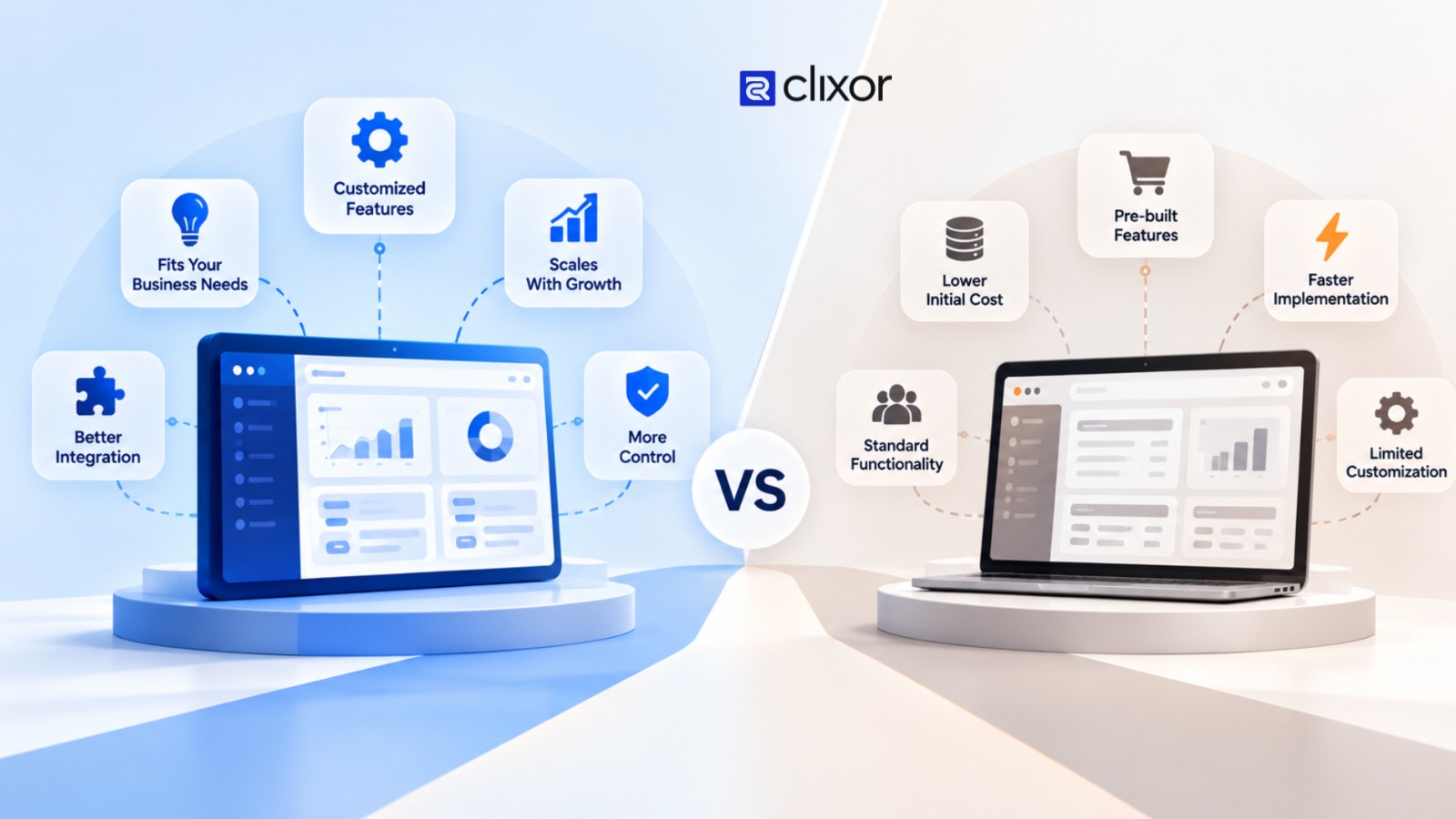
The main difference is flexibility. Off-the-shelf ERP provides predefined functionality, while custom ERP allows businesses to shape how the system works around their specific processes and requirements.
Implementation: Off-the-shelf ERP is generally faster to deploy, while custom ERP requires planning and development.
Cost: Ready-made ERP may require less upfront investment, whereas custom ERP can require a larger initial development budget.
Flexibility: Custom ERP offers greater control over features and workflows.
Scalability: Both can support growth, but custom ERP can be specifically designed around a company’s expected expansion.
Maintenance: Off-the-shelf ERP maintenance is often handled by the software provider. With custom ERP, businesses need an appropriate development and maintenance strategy.
Modern ERP platforms can also support integrations with other business applications. Microsoft notes that ERP systems can connect data and processes across different applications and business functions. Businesses requiring this type of connectivity can also consider API development and integration services.
How Should You Choose?
Start by reviewing your business processes rather than choosing software based only on price.
Ask yourself:
- Are our processes standard or highly specialized?
- Do we need integrations with existing systems?
- How quickly do we need the ERP?
- Will our requirements change significantly as we grow?
- Do we need complete control over features and data workflows?
If your requirements are mostly standard and you need a solution quickly, an off-the-shelf ERP may be suitable. If your business depends on unique workflows and requires greater control, custom ERP may be a better fit.
It is also important to consider security, data management, and integration requirements when evaluating an ERP system. The NIST Cybersecurity Framework provides a widely used framework for managing cybersecurity risks that businesses can consider alongside their technology decisions.
FAQs
1. Is custom ERP better than off-the-shelf ERP?
Not always. The right option depends on business processes, budget, implementation timeline, and long-term requirements.
2. Is custom ERP more expensive?
It can require a higher initial investment because the software is developed specifically for the business.
3. How quickly can an off-the-shelf ERP be implemented?
Implementation depends on the software, business size, configuration, data migration, and training requirements.
4. Can custom ERP integrate with existing software?
Yes. Custom ERP systems can be designed to integrate with relevant business applications and APIs.
5. Can Clixor Tech develop custom ERP software?
Clixor Technologies can help businesses plan and develop software solutions based on their operational requirements, workflows, and growth objectives.
Conclusion
The decision between custom ERP and off-the-shelf ERP should be based on how your business actually operates. An off-the-shelf solution can be practical when standard features meet your requirements, and faster deployment is important.
Custom ERP can be valuable when unique workflows, integrations, flexibility, and long-term control are major priorities.
Before making a decision, document your business processes, identify essential features, compare total costs, and consider future requirements. The best ERP is not necessarily the one with the most features—it is the one that fits your business and helps your teams work more effectively.