SaaS vs Traditional Software: What Is the Difference?
- Introduction
- What Is SaaS Software?
- What Is Traditional Software?
- SaaS vs Traditional Software: Key Differences
- Cost and Investment
- Deployment and Maintenance
- Scalability and Accessibility
- Customization and Control
- Which Is Better for Your Business?
- How Clixor Helps Businesses
- Conclusion
Choosing the right software can directly affect how efficiently a business operates. From managing customers and employees to handling data and daily operations, businesses depend on software for many important tasks.
Today, businesses commonly choose between SaaS software and traditional software. Both can support business operations, but they differ in how they are delivered, managed, maintained, and scaled. Understanding these differences can help businesses choose a solution that fits their needs.
What Is SaaS Software?
SaaS, or Software as a Service, is software hosted by a provider and accessed via the internet. Instead of installing and maintaining the application on your own servers, users can generally access it through a web browser or application.
The provider typically manages hosting, updates, maintenance, and much of the technical infrastructure. Businesses usually pay through a subscription model, making SaaS a convenient option for companies that want to start using software without managing their own infrastructure.
What Is Traditional Software?
Traditional software is usually installed directly on a company's computers or servers. The business purchases the required license and takes greater responsibility for installation, infrastructure, maintenance, updates, and security.
This approach gives businesses more control over their software environment. However, that control also means managing hardware, updates, maintenance, and technical support.
SaaS vs Traditional Software: Key Differences
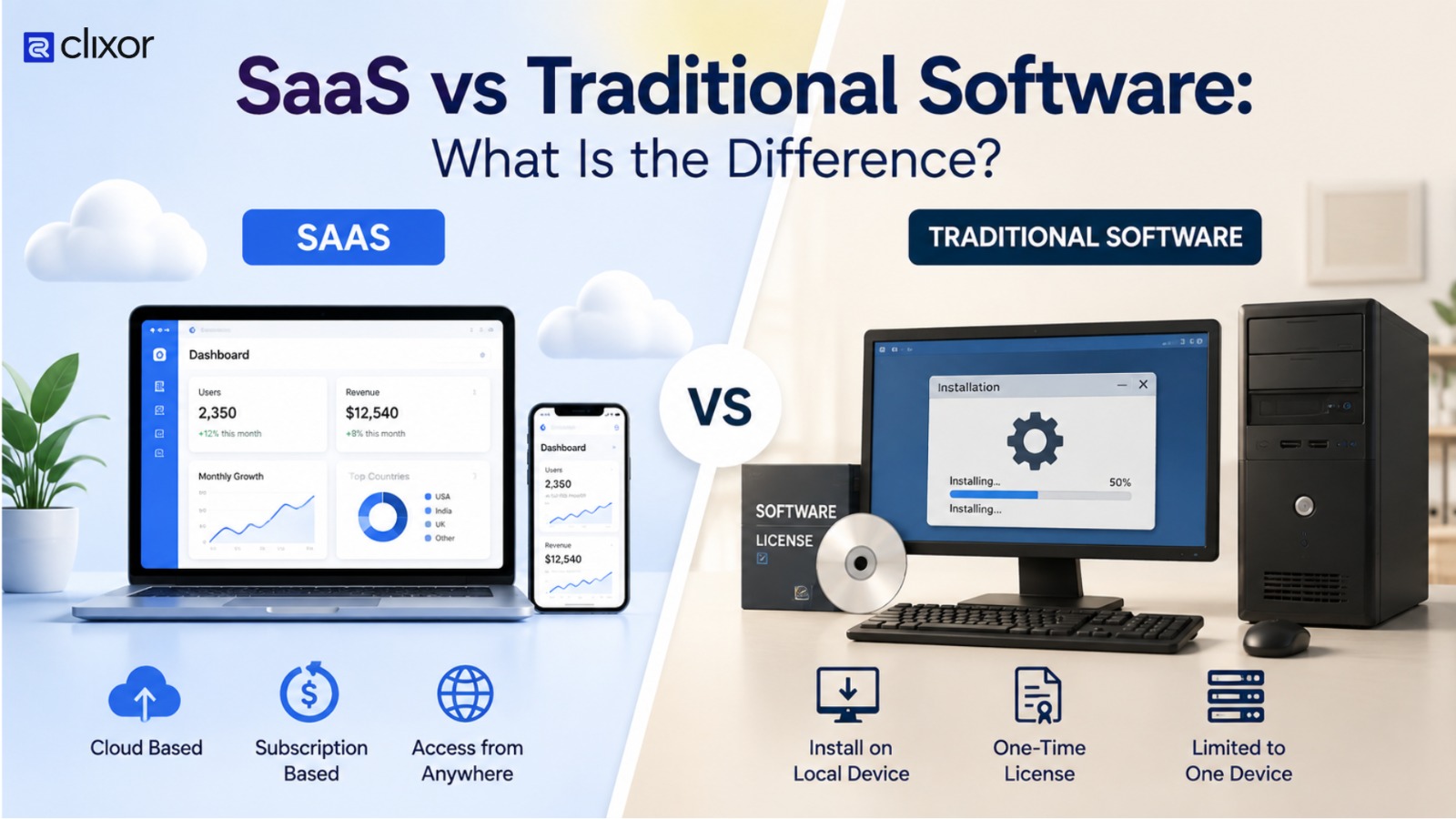
The main difference is how the software is hosted and managed. SaaS is hosted by the provider and accessed online, while traditional software is generally installed and managed within the company's own environment.
This difference affects cost, deployment, maintenance, accessibility, scalability, and control.
Cost and Investment
SaaS commonly uses monthly or annual subscription pricing, which can reduce the initial investment required to start using the software. Traditional software may require a larger upfront investment for licenses, servers, hardware, installation, and infrastructure. Businesses may also have ongoing maintenance and upgrade costs.
Instead of comparing only the initial price, businesses should consider the total cost of ownership and the solution's long-term value.
Deployment and Maintenance
SaaS can generally be deployed faster because the provider manages the underlying infrastructure. Businesses can configure the software and start using it without setting up their own servers. Traditional software usually requires more technical setup, including installation, server configuration, updates, testing, and ongoing maintenance.
For businesses with limited IT resources, SaaS can reduce the technical workload required to maintain software.
Scalability and Accessibility
As businesses grow, their software requirements can change. SaaS platforms generally make it easier to add users, increase usage, or access additional features as requirements change. SaaS also supports accessibility from different locations, making it useful for remote and hybrid teams. Traditional software can also support remote access, but additional infrastructure and configuration may be required.
For growing businesses, flexible and accessible software can make it easier to adapt to changing operational needs.
Customization and Control
Traditional software can provide greater control over the software environment and may be more suitable for businesses with specific customization or infrastructure requirements. SaaS platforms offer configuration and integration options, but businesses may still be limited by the features they provide.
When standard software cannot support unique workflows, custom software development can be a better option. A custom solution can be designed around the business rather than forcing the business to change its processes to fit the software.
Which Is Better for Your Business?
There is no universal answer to the SaaS vs traditional software question.
SaaS can be a good choice for businesses seeking faster deployment, easier maintenance, online access, and flexible scaling. Traditional software may be more suitable for businesses that need greater control, deeper customization, or specific infrastructure requirements.
The right decision depends on your budget, security needs, team structure, existing systems, integration requirements, and long-term business goals.
How Clixor Helps Businesses
Choosing business software should start with understanding the actual problem that needs to be solved. Clixor Technologies provides custom application development, cloud solutions, API integration, ERP, CRM, web development, and mobile application development.
By understanding a business's workflows and technology requirements, the right solution can be selected or developed to support its operations and future growth.
Conclusion
SaaS and traditional software both have their advantages. SaaS focuses on accessibility, flexibility, scalability, and provider-managed infrastructure, while traditional software provides greater control over the software environment.
The best choice is not necessarily the newest or most popular option. It is the one that fits your business requirements, budget, security needs, and plans.
The right software should support your business, not make your business adapt to it.