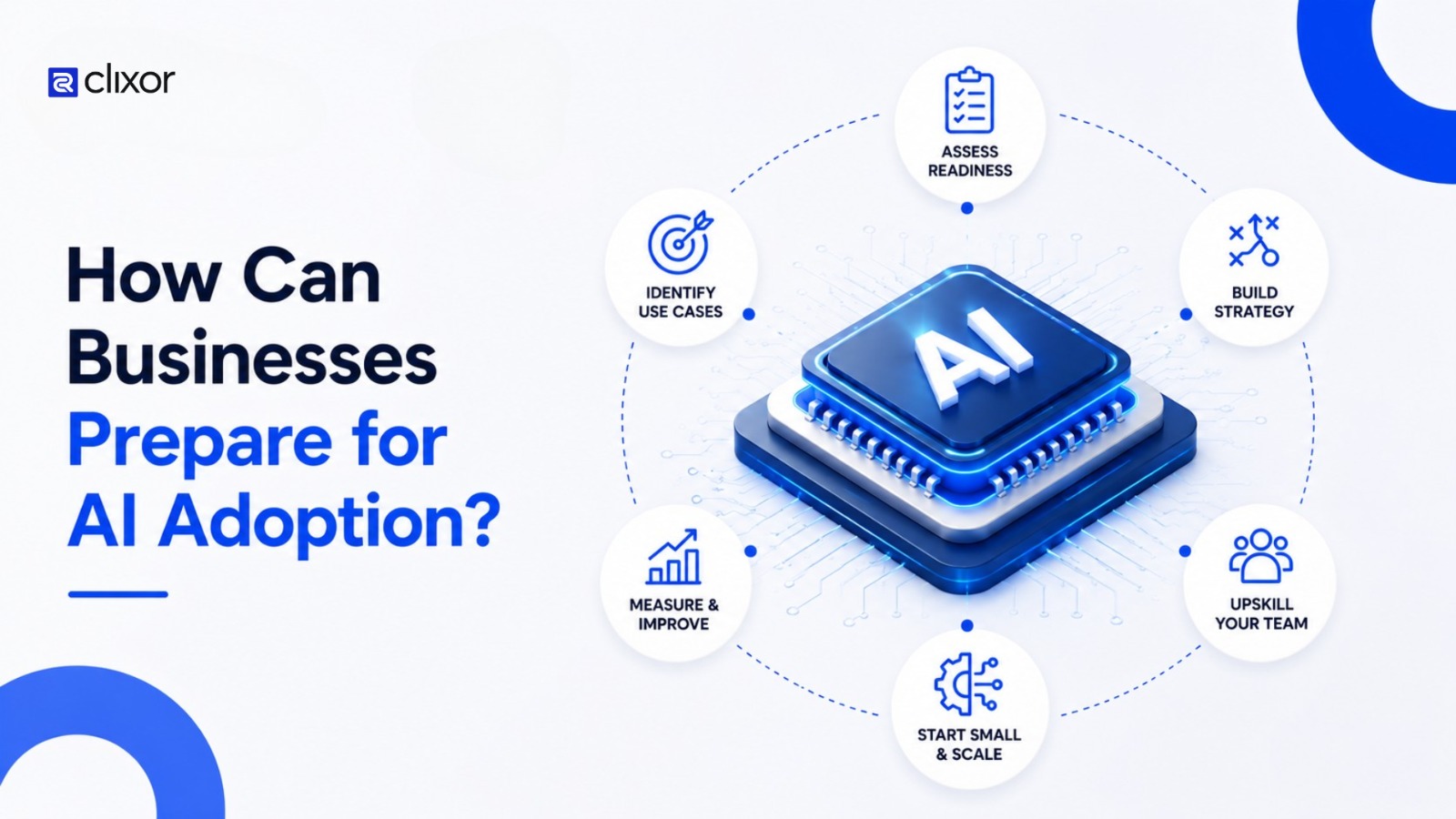
How Can Businesses Prepare for AI Adoption?
- Start With a Clear Business Problem
- Prepare Your Business Data
- Review Your Technology Infrastructure
- Make Security Part of the Strategy
- Prepare Employees for AI
- Start Small and Measure Results
- AI Adoption and SEO
- Common AI Adoption Mistakes
- A Practical Approach to AI Adoption
- Conclusion
Artificial intelligence is becoming an important part of modern business. From customer support and data analysis to automation and marketing, businesses are finding practical ways to use AI. But successful AI adoption is not simply about purchasing an AI tool. Companies need the right strategy, reliable data, secure systems, and employees who understand how to use the technology.
The first step is to identify where AI can solve a real business problem. Instead of adopting AI just because it is trending, businesses should focus on repetitive tasks, operational delays, customer service challenges, and processes that require excessive manual work.
Start With a Clear Business Problem
Before choosing an AI solution, understand what the business actually needs to improve.
For example, a company receiving hundreds of customer enquiries may spend considerable time manually sorting and assigning them. An AI assisted system could help categorize those enquiries and allow employees to focus on customers who need immediate attention.
This approach is more effective than introducing AI across multiple departments without a clear purpose.
Prepare Your Business Data
Data is an important part of AI adoption. Many businesses have information spread across CRM systems, spreadsheets, databases, websites, and internal applications. If this information is outdated, duplicated, or poorly organized, implementing AI becomes more difficult.
Businesses should therefore review their existing data and make sure important information is accurate, accessible, and properly protected. Good data preparation also makes future software integrations and automation projects easier.
Review Your Technology Infrastructure
AI often needs to connect with existing business systems. Websites, web applications, databases, CRM platforms, ERP systems, and APIs should be reviewed before implementation.
A strong technology foundation allows AI to work within existing business processes instead of becoming another disconnected application. For companies planning digital transformation, modern web development and reliable system integration can make future AI adoption much smoother.
Make Security Part of the Strategy
Businesses also need to consider security and privacy before introducing AI. Employees may work with customer information, financial records, internal documents, or other confidential data.
Clear guidelines should explain which AI tools employees can use, what information can be shared, and when human review is required. AI security should be considered during planning rather than treated as an afterthought.
Prepare Employees for AI
AI adoption is not only a technology decision. Employees need to understand how AI can support their work and where human judgment remains important.
For example, AI can help create a first draft of a customer response, but an employee should still review the information before sending it. Proper training helps employees use AI productively while reducing mistakes and misuse.
Start Small and Measure Results
Businesses do not need to transform everything at once. A small pilot project is often a better starting point.
A company could test AI for customer enquiry classification, document processing, internal knowledge search, or lead management. After implementation, the business can compare time saved, accuracy, response times, employee feedback, and other relevant results.
If the solution produces meaningful improvement, it can gradually be expanded.
AI Adoption and SEO
AI is also changing how customers search for information online. Search engines and AI-powered search experiences increasingly rely on useful, well-structured information to understand businesses and their services.
This makes a strong website more important. Businesses should continue investing in clear service pages, helpful content, mobile-friendly design, good internal linking, accurate business information, and trustworthy content.
Good SEO is not simply about adding keywords. It is about making information easy for users and search systems to understand.
Common AI Adoption Mistakes
One common mistake is purchasing too many AI tools without a clear strategy. Another is automating an inefficient process without fixing the underlying problem.
Businesses should also avoid assuming that AI outputs are always correct. Human review remains important for tasks involving customers, business decisions, sensitive information, or important company processes.
Most importantly, Artificial Intelligence should not be treated as an IT-only project. Management, employees, marketing, operations, and technology teams all have a role in successful adoption.
A Practical Approach to AI Adoption
A sensible AI adoption process starts with understanding existing business processes. From there, identify one high-value opportunity, prepare the required data, review the technology infrastructure, establish security guidelines, and run a controlled pilot.
Once the results are clear, the business can improve the solution and gradually expand it.
This practical approach reduces unnecessary investment and gives businesses real experience before committing to larger AI projects.
Conclusion
Preparing for AI adoption is not about following every new AI trend. It is about understanding where technology can create genuine business value.
Businesses that prepare their data, infrastructure, security, employees, and processes will be in a stronger position to use AI effectively.
The important question is not “Where can we use AI?”
It is “Which business problem can AI help us solve better?”
With the right technology strategy, businesses can combine AI with modern websites, software development, automation, and digital solutions to build more efficient and scalable operations.