How Microservices Can Support Growing Web Applications
As a web application grows, its features, users, and technical requirements become more complex. Managing everything in one large application can make development, testing, and scaling harder.
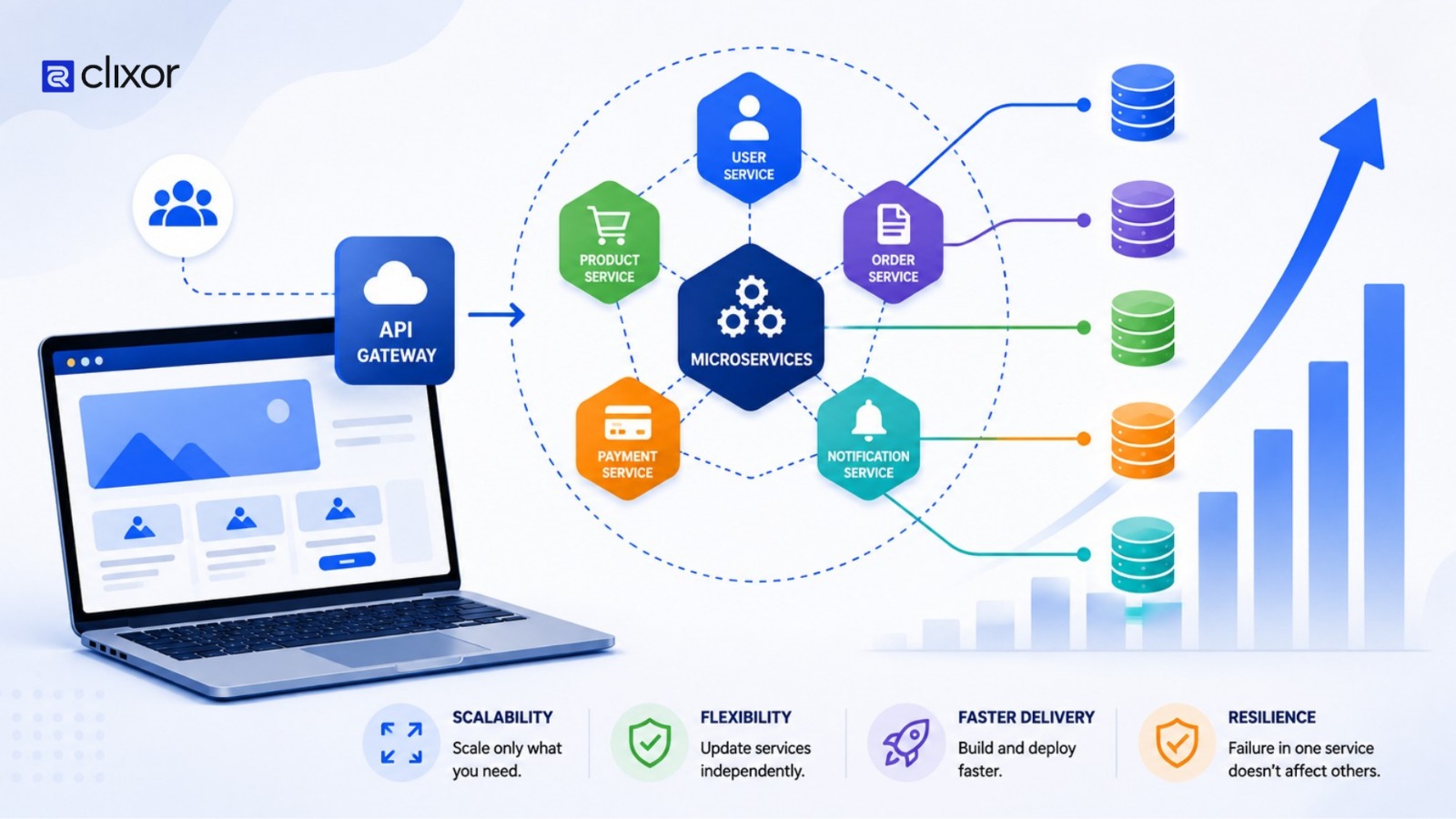
Microservices architecture offers another approach. It divides an application into smaller, independent services, with each service handling a specific business function.
For growing web applications, this approach can make it easier to develop new features, scale individual components, and manage changes without affecting the entire system.
- What Are Microservices?
- Why Microservices Can Help Growing Applications
- Microservices and Application Performance
- Challenges of Using Microservices
- When Should a Web Application Consider Microservices?
- Conclusion
What Are Microservices?
Microservices are small, independent services that work together to form a complete application.
Instead of building every feature into one large codebase, you can separate different functions into services.
For example, an e-commerce application could have separate services for:
- User accounts
- Product management
- Orders
- Payments
- Notifications
Each service can have its own logic and can communicate with other services through APIs or messaging systems.
Why Microservices Can Help Growing Applications
1. Individual Services Can Scale
Not every part of an application needs the same amount of resources.
For example, an online store may receive many product searches but fewer payment requests. With microservices, you can scale the product-related service independently when demand increases.
This makes resource usage more flexible than scaling the entire application.
2. Teams Can Work on Different Services
As a project grows, multiple developers or teams may work on different features.
With a well-designed microservices architecture, teams can work on separate services without constantly modifying the same large codebase.
For example, one team can work on the payment service while another works on the user account service.
This can make development more organized and allow teams to work more independently.
3. Changes Can Be More Isolated
In a large application, changing one part can sometimes create unexpected problems elsewhere.
Microservices can isolate certain changes within individual services.
For example, a notification service can be updated without changing the core order-processing logic, provided the service interfaces remain compatible.
This can make testing and deployment easier to manage.
Microservices and Application Performance
Microservices do not automatically make an application faster. In fact, communication between multiple services can introduce additional complexity and network overhead.
The main advantage is flexibility.
When a particular service becomes a bottleneck, developers can investigate and optimize that service without necessarily changing the entire application.
Caching, database optimization, load balancing, and efficient communication between services are still important for overall performance.
Challenges of Using Microservices
Microservices can be useful, but they are not the right solution for every project.
A microservices architecture introduces additional operational complexity. Developers need to manage service communication, monitoring, deployment, security, logging, and failure handling across multiple components.
For a small application, a monolithic architecture may be simpler and more practical.
Microservices become more useful when an application has grown enough to benefit from independent scaling, deployment, and service ownership.
When Should a Web Application Consider Microservices?
There is no fixed application size at which a business must switch to microservices.
It may be worth considering when:
- Different parts of the application need to scale independently.
- Multiple teams are working on separate business areas.
- Deploying the entire application for every small change is becoming difficult.
- Different services have different technical requirements.
- The application has clear and stable business boundaries.
The architecture should be selected based on the application's actual needs rather than following a trend.
Conclusion
Microservices can support growing web applications by separating complex functionality into smaller, manageable services. This can improve flexibility for scaling, development, deployment, and maintenance.
However, microservices also introduce additional complexity. A well-structured monolithic application may be the better choice for smaller projects.
At Clixor Technologies, we understand that every web application has different requirements. For businesses planning long-term application growth, choosing the right architecture from the beginning can make future development and scaling easier. If microservices fit your needs, planning the transition early can help build a more flexible and scalable application.