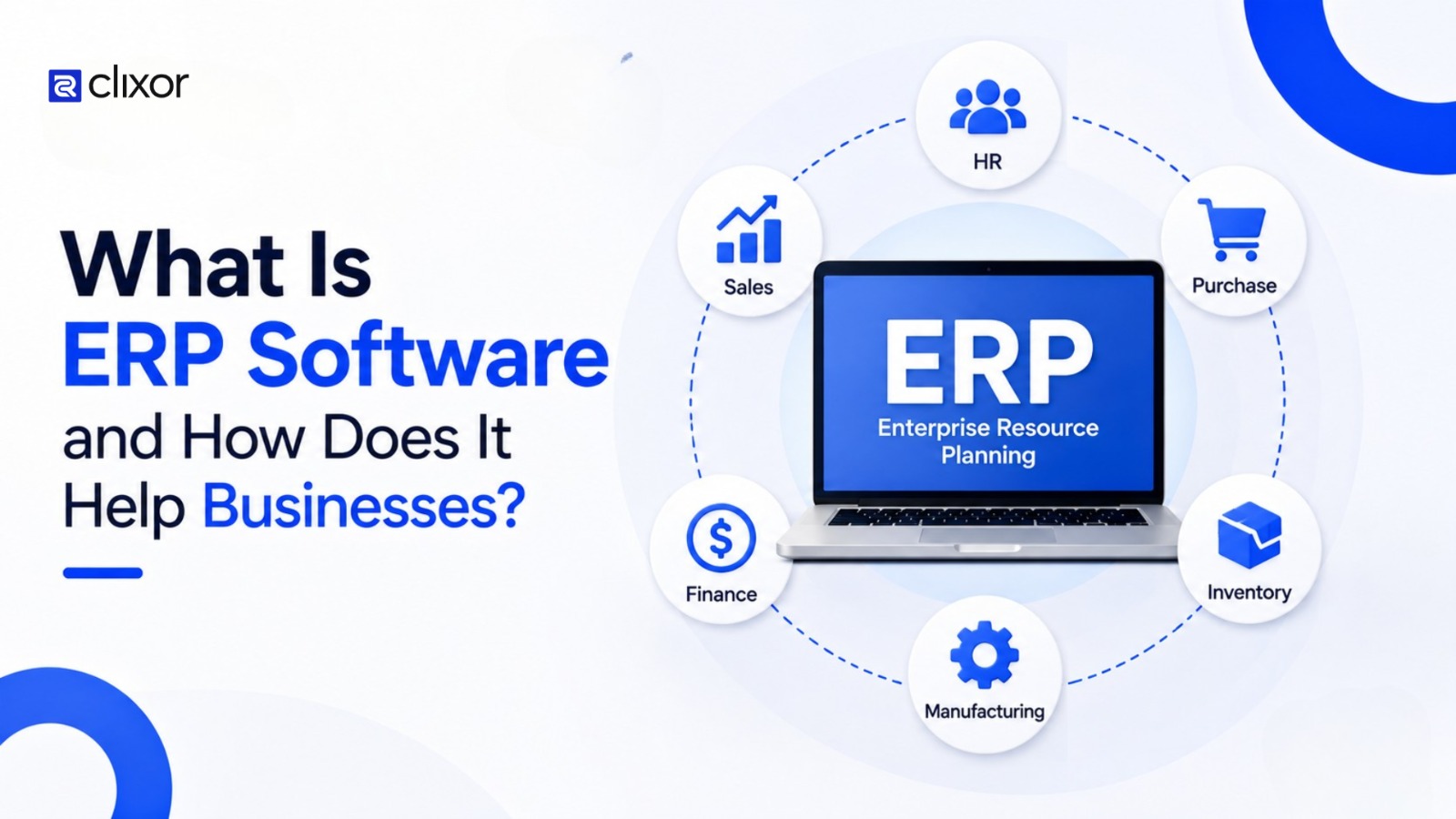
What Is ERP Software and How Does It Help Businesses?
- What Is ERP Software?
- What Are the Main Modules of ERP Software?
- How Does ERP Help Businesses?
- Why Are Businesses Moving to ERP Systems?
- Is ERP Software Suitable for Every Business?
- Conclusion
As businesses grow, managing sales, finance, inventory, employees, customers, and daily operations can become difficult when everything is handled separately. ERP software helps businesses bring these activities together into a single centralised system.
But what exactly is ERP, and how can it help a business work more efficiently?
What Is ERP Software?
ERP (Enterprise Resource Planning) software is a business management system that integrates multiple departments and processes into a single platform.
Instead of using separate tools for accounting, inventory, sales, HR, and other operations, businesses can manage them through an integrated ERP system.
For example, when a sales order is created, the relevant information can be connected with inventory, billing, and financial records. This reduces repetitive data entry and improves visibility across the business.
What Are the Main Modules of ERP Software?
ERP systems can include different modules depending on the organisation's needs.
Common modules include:
- Finance & Accounting – Manage invoices, expenses, payments, and financial records.
- Inventory Management – Track stock levels, products, purchases, and warehouses.
- Sales Management – Manage quotations, orders, customers, and sales activities.
- Human Resources – Handle employee information, attendance, leave, and payroll.
- Procurement – Manage suppliers, purchase orders, and purchasing activities.
- CRM – Organise customer information and interactions.
- Production Management – Plan and monitor manufacturing processes.
Businesses can select the modules that are relevant to their operations.
How Does ERP Help Businesses?
1. Centralises Business Data
ERP brings important business information into one system. Employees can work with shared data instead of maintaining multiple disconnected files and applications.
2. Reduces Manual Work
Automating repetitive tasks can reduce data entry and administrative effort. For example, information entered during a sales process can be used across other connected processes.
3. Improves Business Visibility
Managers can get a clearer view of sales, inventory, finances, and operations. This makes it easier to understand what is happening across the business.
4. Improves Accuracy
When information is entered and maintained in a centralised system, businesses can reduce duplicate records and manual errors.
5. Supports Better Decision-Making
ERP systems can provide reports and dashboards that help businesses analyse performance and make decisions using current business information.
Why Are Businesses Moving to ERP Systems?
As organizations expand, spreadsheets and disconnected software can become difficult to manage.
An ERP system can provide a more structured way to manage business processes while allowing different departments to work with connected information.
It can be especially useful for businesses managing multiple teams, locations, products, customers, or operational processes.
Is ERP Software Suitable for Every Business?
Not necessarily.
A very small business with simple operations may not need a full ERP system. However, businesses experiencing operational complexity, data duplication, or difficulty coordinating departments may benefit from ERP.
The right ERP solution should be selected based on the company's size, industry, processes, and future growth plans.
Conclusion
ERP software helps businesses connect their core operations through a centralised system. Clixor Technologies helps businesses explore technology solutions that bring departments and business data together, reduce manual work, improve visibility, and support more efficient decision-making.
For businesses planning to scale, choosing the right ERP system can be an important step toward building more organized and connected operations. Clixor Technologies focuses on practical technology solutions designed to support growing businesses and their evolving operational needs.